

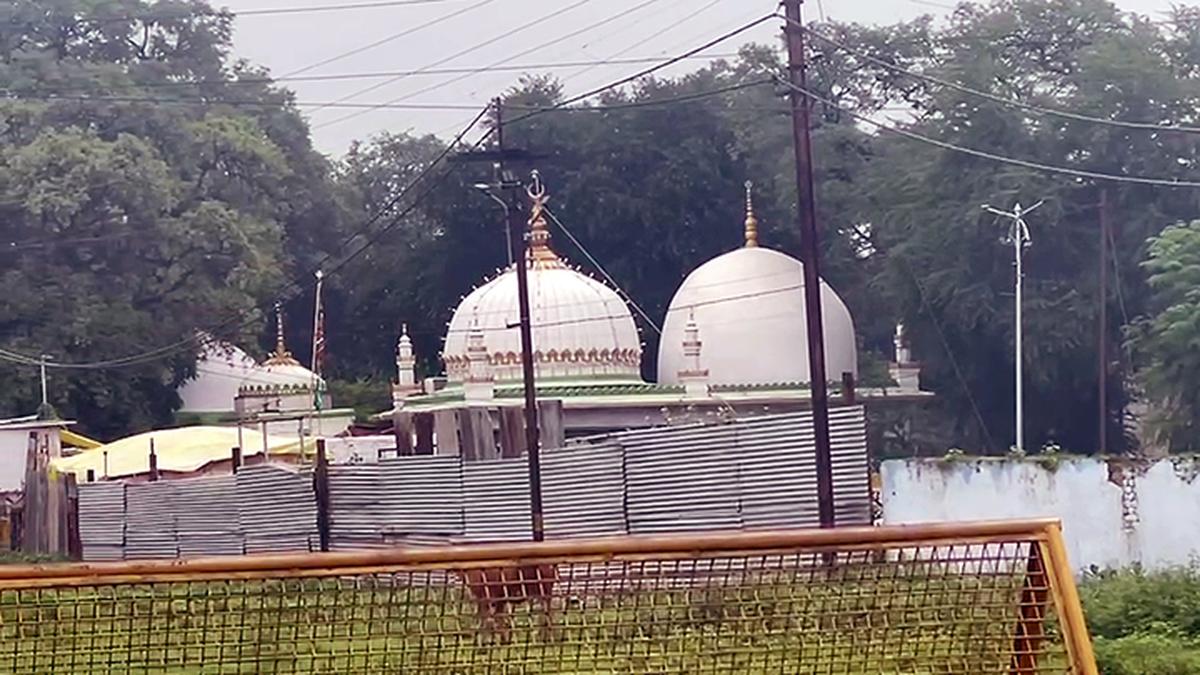
The Indore Bench of the Madhya Pradesh High Court ruled that the disputed Bhojshala-Kamal Maula Mosque complex in Dhar is religiously characterized as Bhojshala, a temple dedicated to Goddess Vagdevi Saraswati.
A Division Bench of Justice Vijay Kumar Shukla and Justice Alok Awasthi delivered the verdict while allowing petitions filed by Hindu Front for Justice and connected parties. The Court set aside portions of the Archaeological Survey of India’s April 7, 2003 arrangement that restricted Hindu worship within the complex while permitting the Muslim community to offer Friday namaz at the site.
The Court held that Hindu worship at the monument had continued over time and was never extinguished.
Background of the Case
The dispute concerns the Bhojshala-Kamal Maula complex in Dhar, a protected monument under the Ancient Monuments and Archaeological Sites and Remains Act, 1958.
The Hindu side claimed the site was originally a Saraswati temple established during the reign of Raja Bhoj and used as a centre for Sanskrit learning. The Muslim side maintained that the structure functioned as a mosque and relied on historical usage and administrative arrangements permitting namaz.
In 2003, the ASI issued a circular permitting Hindus to perform puja on Tuesdays and Muslims to offer namaz on Fridays.
Several petitions were later filed challenging the arrangement and seeking declaration of the site’s original religious character.
What Happened During the Hearing
During the proceedings, the ASI defended its scientific survey and archaeological findings, arguing that inscriptions, sculptures and architectural remains indicated the existence of a pre-existing temple structure.
Senior Advocate Salman Khurshid, appearing for the Muslim parties, opposed the findings and argued that the dispute was barred by the Places of Worship Act, 1991.
The Court also considered submissions from Jain parties claiming links between the site and Jain religious heritage.
Court’s Key Observation
The High Court said archaeological interpretation could legitimately rely on scientific studies conducted by the ASI.
The Bench observed that Hindu religious practices at the site had continued in a regulated form over the years and were never completely discontinued.
The Court further held that historical literature and architectural evidence established Bhojshala as a centre of Sanskrit learning associated with Raja Bhoj and indicated the existence of a Saraswati temple at Dhar.
The Bench emphasized that governments have a constitutional obligation under Articles 25 and 26 to preserve monuments, temples and sites of historical and spiritual importance.
Court’s Decision
The Court declared that the religious character of the disputed site is that of Bhojshala, containing a temple dedicated to Goddess Vagdevi Saraswati.
It directed the Union Government and the ASI to take decisions regarding administration of the temple and Sanskrit learning activities, while clarifying that the ASI would continue supervising preservation and conservation of the monument.
The Court also asked the Centre to consider representations seeking the return of the idol believed to be housed in a London museum.
At the same time, the Bench protected the interests of the Muslim community by directing the Madhya Pradesh government to consider allotment of suitable permanent land in Dhar district for construction of a mosque if an application is made.


