

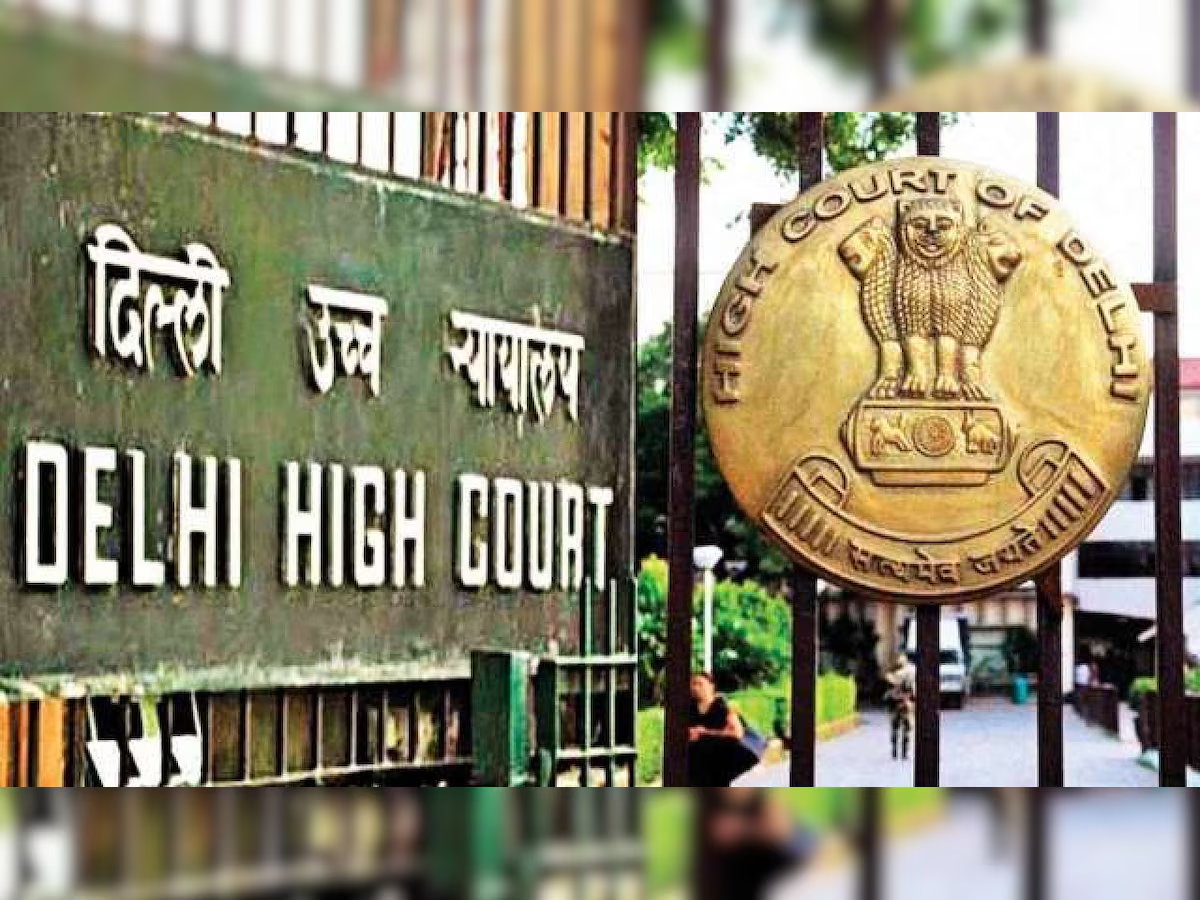
The Delhi High Court dismissed a long-pending petition seeking to declare a decades-old land acquisition as lapsed, holding that compensation had been duly deposited and that the claim was raised far too late. The court refused to grant any relief to the landowners, who had argued that their land in west Delhi was never taken over and that payment was not made under the law.
The decision was delivered by a division bench of the Delhi High Court, bringing to an end a dispute linked to an acquisition initiated more than 65 years ago in Village Basai Darapur.
The petition was filed by the legal heirs of late Mohan Lal, who owned land measuring about 4 bighas and 14 biswas. They sought a declaration that the acquisition had lapsed under Section 24(2) of the Right to Fair Compensation and Transparency in Land Acquisition Act, 2013, and also asked the court to restrain authorities from interfering with their possession.
Read also:- Supreme Court Upholds ₹9.47 Cr Environmental Penalty on Pune Builders, Backs 'Polluter Pays' Rule
However, after hearing both sides, the bench declined to interfere, noting that the compensation had been deposited in court way back in 1965 and that the petitioners themselves had pursued enhanced compensation for years.
The land in question was notified for acquisition in November 1959 for the planned development of Delhi, with the Delhi Development Authority as the beneficiary. A final declaration followed in 1963, and an award was passed in May 1964.
Dissatisfied with the compensation fixed at that time, Mohan Lal sought enhancement under the Land Acquisition Act, 1894. The compensation amount was deposited by the Land Acquisition Collector before the civil court in February 1965.
Read also:- Delhi High Court Rejects Sameer Wankhede’s Defamation Suit Against Netflix Show ‘Ba*ds of Bollywood’**
Around the same time, a title dispute arose when a private builder claimed a share in the compensation. This led to separate proceedings for apportionment, during which the disbursement of the amount remained stayed at the request of the landowner himself.
The petitioners argued that neither possession of the land was taken nor was compensation ever paid to them. Relying on Supreme Court judgments, they claimed that both conditions were required to be fulfilled for the acquisition to survive after the 2013 law came into force.
They also contended that mere deposit of money in court could not be treated as payment, especially when the amount was never actually released to the landowners.
The government, however, strongly opposed the plea. Counsel for the Union of India and the Delhi Development Authority submitted that the compensation was deposited in court as early as 1965 and that the landowner had full knowledge of this fact. They pointed out that the family had actively litigated for higher compensation and even pursued execution proceedings later.
Read Also:- Delhi High Court Upholds Engineers’ Pay Upgrade, Orders NFU Benefits With Interest
Justice Nitin Wasudeo Sambre, speaking for the bench, noted that there was no clear material on record to show that physical possession of the land had been taken by the authorities. On this aspect, the court accepted that possession appeared to remain with the petitioners.
However, the bench made it clear that this alone was not enough to claim lapse of acquisition under the 2013 Act.
The judges referred extensively to the Supreme Court’s ruling in Indore Development Authority v. Manohar Lal, observing that both conditions — non-taking of possession and non-payment of compensation — must exist together.
The bench observed that the compensation amount had been deposited in the reference court under the 1894 Act due to the title and apportionment dispute.
“The factual record shows that the compensation was deposited and that the landowner was aware of it. The proceedings remained stalled at the behest of the landowner himself,” the court noted.
The judges also pointed out that once the enhancement proceedings and apportionment disputes came to an end, it was open to the landowners to apply for withdrawal of the amount.
In its final order, the High Court held that the petitioners failed to satisfy the mandatory conditions for claiming lapse of acquisition under Section 24(2) of the 2013 Act. The court said the plea was not only meritless but also suffered from unexplained delay, as the acquisition had attained finality decades ago.
Relying on Supreme Court precedents, the bench observed that stale and concluded claims cannot be revived merely because a new law has come into force.
“The compensation was duly deposited, and the petitioners cannot take advantage of their own inaction,” the court held while dismissing the petition.
With this, the writ petition was rejected, and all pending applications were disposed of, bringing the long-running dispute to a close.
Case Title and Case Number: Shri Rameshwar Singh Tanwar & Ors. v. Union of India & Ors., W.P.(C) 1442/2015
Bench: Justice Nitin Wasudeo Sambre and Justice Anish Dayal
Download Judgment

