

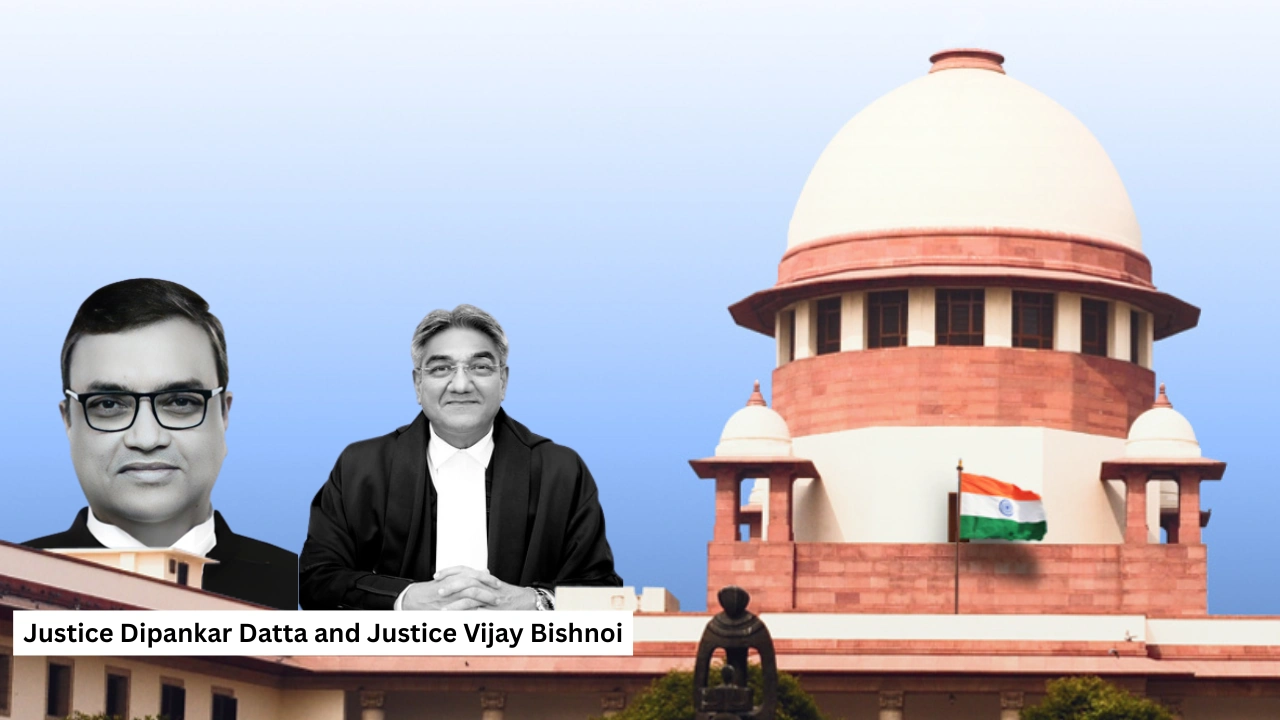
In a significant ruling reinforcing environmental accountability, the Supreme Court of India on Thursday upheld hefty environmental compensation imposed on two real estate developers in Pune for violating environmental laws. The court dismissed appeals filed by Rhythm County and Keystone Properties, affirming that builders cannot escape liability merely because a fixed formula for penalties does not exist.
The judgment, delivered by a Bench of Justice Dipankar Datta and Justice Vijay Bishnoi, strongly endorsed the powers of the National Green Tribunal (NGT) to impose penalties based on project size and environmental impact.
Read Also:-Kerala High Court Quashes Suicide Abetment Case, Says Angry Words Alone Don’t Prove Criminal
Background of the Case
The case arose from two separate complaints filed before the NGT’s Western Zone Bench in Pune.
• Rhythm County, a real estate developer, had undertaken a large housing project at Autade Handewadi, Pune.
• Keystone Properties developed a residential project at Punawale, Pune.
Both were accused of carrying out construction without mandatory environmental clearances, continuing work despite stop-work notices, and violating pollution control norms.
Following inspections, the NGT found serious lapses and imposed:
• ₹5 crore penalty on Rhythm County
• ₹4.47 crore penalty on Keystone Properties
Both developers challenged the orders before the Supreme Court.
Read Also:-Delhi High Court Rejects Sameer Wankhede’s Defamation Suit Against Netflix Show ‘Ba*ds
What the Builders Argued
Senior lawyers appearing for the developers claimed that:
• Environmental compensation was imposed without a clear statutory formula.
• The CPCB (Central Pollution Control Board) guidelines were wrongly applied.
• There was no proof of actual environmental damage.
• The NGT mechanically accepted committee reports without independent analysis.
They argued that merely violating procedural norms should not attract such heavy financial penalties.
What the Court Observed
The Supreme Court firmly rejected these arguments.
The Bench observed:
“Environmental compensation cannot be illusory. It must reflect the scale of the project and the gravity of violations.”
The Court clarified that:
• The NGT has wide powers under Sections 15 and 20 of the NGT Act.
• Environmental compensation need not wait for a rigid statutory formula.
• Project cost and scale are valid indicators of environmental impact.
• The “polluter pays” principle allows courts to impose meaningful deterrence.
Importantly, the Court held that environmental damage is not limited to visible pollution but includes systemic harm caused by illegal construction.
Read Also:-UGC's 2026 Anti-Discrimination Rules Face Protest by Lawyers Near Allahabad High Court
Why the Compensation Was Upheld
For Rhythm County, the Court noted:
• Construction continued despite stop-work orders.
• Deviations were made from sanctioned plans.
• The project cost exceeded ₹335 crore.
• A ₹5 crore penalty amounted to only 1.49% of total project cost.
For Keystone Properties, the Court observed:
• Construction continued for years without statutory consents.
• Occupation began without environmental clearance.
• The penalty of ₹4.47 crore was proportionate to violations and project size.
The Bench ruled that the NGT was justified in using project cost as a benchmark, citing earlier judgments including Goel Ganga Developers v. Union of India.
• Environmental compensation need not follow a fixed formula.
• CPCB guidelines are indicative, not binding.
• NGT can rely on expert reports but must apply its own reasoning.
• Larger projects can justifiably face higher penalties.
• “Polluter Pays” principle applies even without visible pollution.
The Court emphasized:
“Environmental protection is not a technical formality. Economic benefit cannot outweigh ecological responsibility.”
Read Also:-Supreme Court Sets Aside Odisha Land Dispute Orders, Says Section 47 CPC Misused After Decree
Final Decision
The Supreme Court dismissed both appeals and upheld the NGT’s orders.
• ₹5 crore penalty on Rhythm County confirmed
• ₹4.47 crore penalty on Keystone Properties upheld
• Three months’ time granted to deposit the amount
• No interference with NGT’s reasoning
Case Title: M/s Rhythm County v. Satish Sanjay Hegde & Ors.
Case Numbers: Civil Appeal Nos. 7187 & 7974 of 2022
Decision Date: January 30, 2026
Download Judgment

