

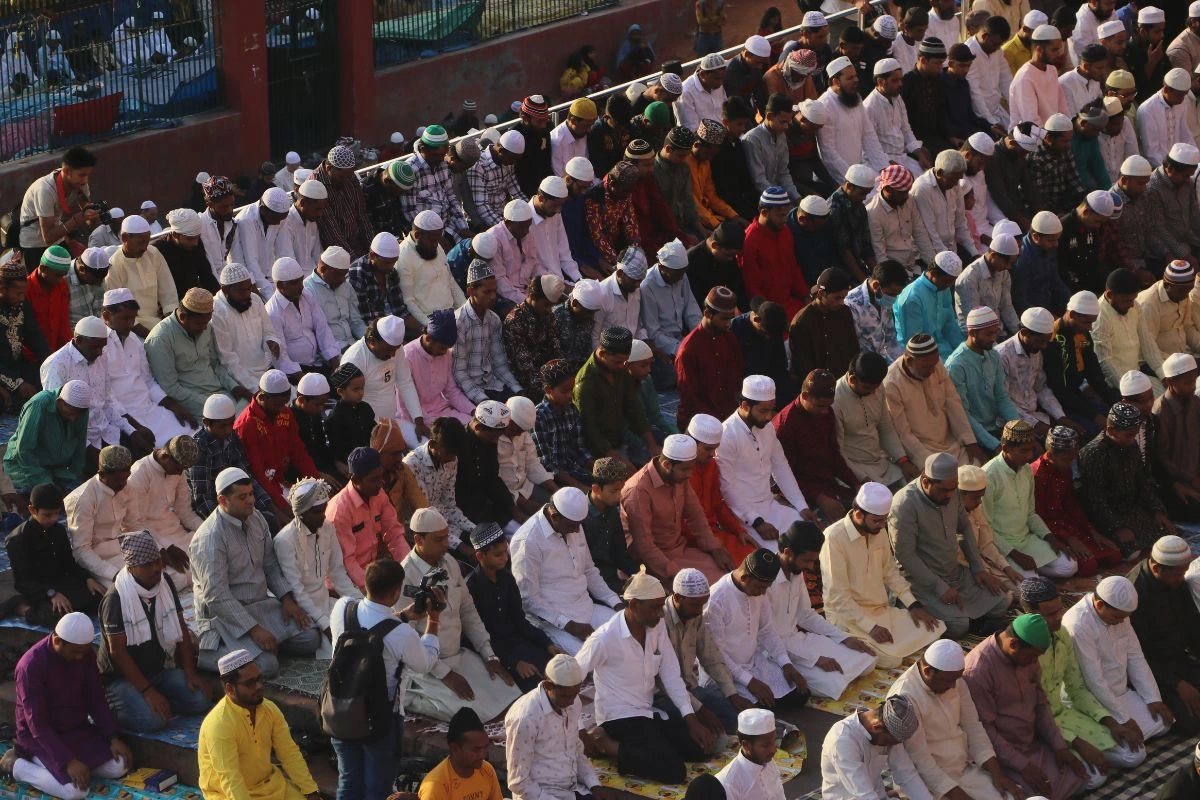
The Allahabad High Court recently questioned the Uttar Pradesh administration for restricting the number of people offering Namaz during Ramzan at a disputed site in Sambhal district. During the hearing, the bench emphasized that maintaining law and order is the responsibility of the State and cannot be used as a reason to limit religious worship at a private place.
Background of the Case
The petition was filed by Munazir Khan, who approached the court claiming that authorities had prevented worshippers from offering Namaz at a site identified as Gata No. 291 in Sambhal during the month of Ramzan.
According to the petitioner, a mosque exists on the land and worshippers traditionally gather there for prayers. However, local authorities allowed only twenty people to offer Namaz at the site, citing potential law and order concerns
Read also:- Calcutta High Court Upholds Life Term in Murder Case, Says Evidence Clearly Points to Accused
The State disputed the petitioner’s claim about the ownership of the land. Government counsel told the court that revenue records list the property in the names of Mohan Singh and Bhooraj Singh, sons of Sukhi Singh.
During the hearing, the court also noted that the petitioner had not yet submitted photographs or other evidence clearly showing the existence of a mosque or a designated place of worship at the site.
A division bench comprising Justice Atul Sreedharan and Justice Siddharth Nandan expressed strong reservations about the State’s justification for restricting the number of worshippers.
The bench said that citing possible law and order problems cannot be an excuse for limiting people’s right to worship.
“The State cannot say that because there may be a law and order problem, the number of worshippers must be restricted,” the bench observed during the hearing.
In a sharp remark directed at local authorities, the court said that if officials feel unable to maintain order, they should reconsider their position.
The bench observed,
“If the Superintendent of Police and the Collector believe they cannot enforce law and order, they should either resign or seek transfer outside Sambhal.”
Read also:- Supreme Court Debates 3-Year Practice Rule for Civil Judges; Application Deadline Extended
The court further emphasized that it is the State’s duty to ensure that people of every community can worship peacefully at their designated place of worship.
It also reiterated an earlier legal position: when prayers or religious functions are held on private property, permission from the State is not required. However, if such gatherings spill onto public land or public property, then authorities can regulate them and require prior permission.
During the hearing, the State sought time to obtain further instructions regarding the dispute.
The petitioner also informed the court that he would file a supplementary affidavit, including photographs and revenue documents, to establish the exact location where Namaz is being offered.
After hearing the parties, the court allowed time for both sides to place additional materials on record.
The bench directed that the matter be listed again on 16 March 2026, placing it among the top ten cases for hearing on that date.
Case Title: Munazir Khan vs State of U.P. and 4 Others
Case Number: Writ - C No. 5996 of 2026
Date of Order: 27 February 2026
Counsels
• Counsel for Petitioner: Wahaj Ahmad Siddiqui
• Counsel for Respondent (State): C.S.C. (Chief Standing Counsel)


