

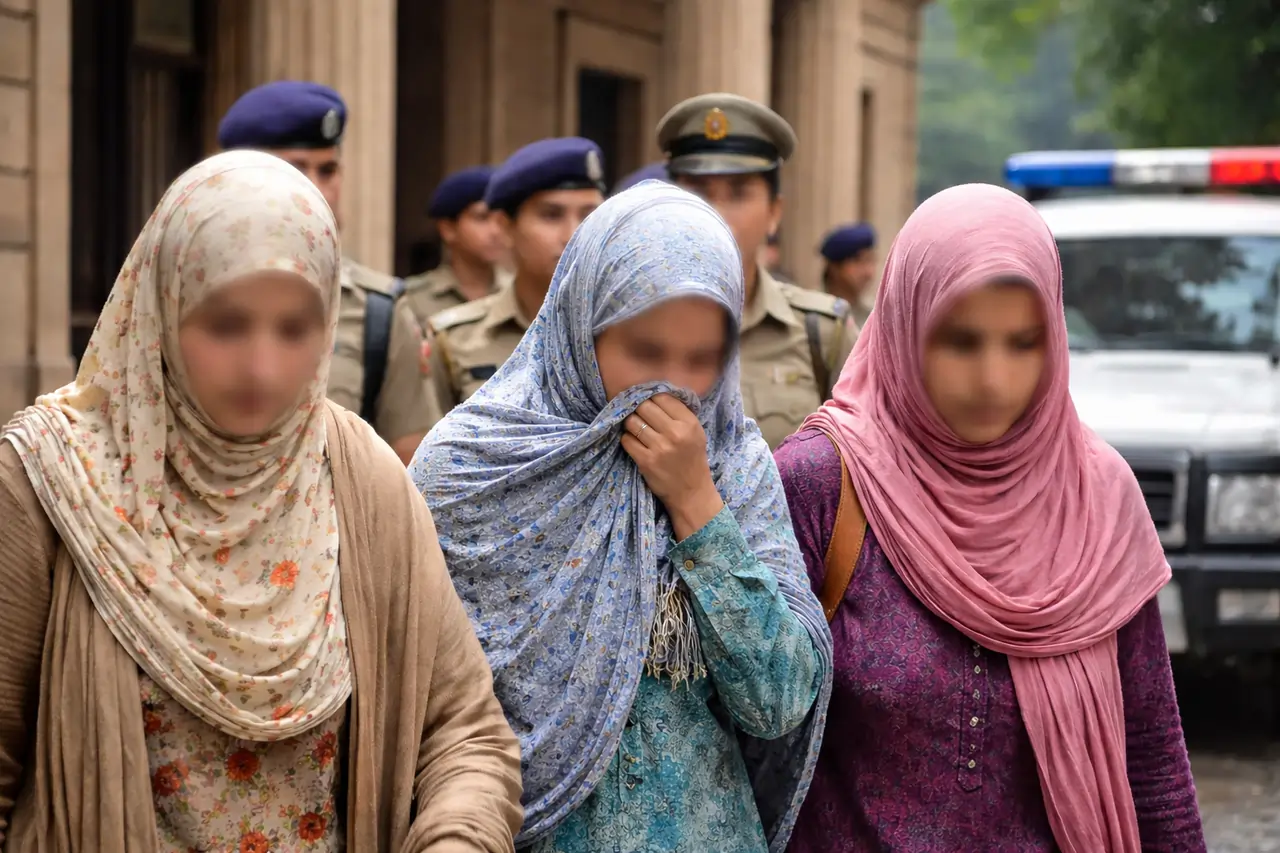
The Jammu & Kashmir High Court has granted bail to three women accused in a murder case arising from a violent land dispute in Anantnag district, observing that trial courts must seriously consider the special legal protection available to women under criminal law.
हिंदी में पढ़ें
Justice Rahul Bharti, while allowing the bail plea, noted that the lower court failed to apply the proviso meant specifically for women accused of non-bailable offences, even though the law clearly mandates such consideration.
Read also:-Patna High Court Orders NIOS to Correct Student’s Marksheet After Record Error
Background of the Case
The case stems from FIR No. 21/2023 registered at Police Station Larnoo, Anantnag, based on a complaint by Ghulam Mohi-ud-Din Dar. He alleged that a group of neighbours attacked his father, Ali Mohammad Dar, following a dispute over construction of a cattle shed on adjoining pasture land.
According to the complaint, the incident occurred on the night of 19 July 2023, when several accused allegedly entered the complainant’s house, damaged property, and assaulted family members with sticks. Ali Mohammad Dar suffered serious head injuries and later succumbed on 31 July 2023, following which Section 302 (murder) of the Indian Penal Code was added.
The police eventually filed a chargesheet against fourteen accused persons. Among them were three women - Saleema Bano, Reshma, and Rubina - who were arrested in early 2024 and remained in judicial custody as undertrials.
The three women initially sought bail before the Principal Sessions Judge, Anantnag. However, their applications were rejected in late 2024 on the ground that the trial was at an advanced stage and that their conduct during investigation did not justify bail.
The trial court also made observations suggesting that evidence recorded so far did not absolve them of culpability - remarks that later drew sharp criticism from the High Court.
High Court’s Observations
Justice Rahul Bharti took serious note of the trial court’s approach. The High Court observed that the Sessions Court overlooked the proviso to Section 437(1) of the Code of Criminal Procedure, which allows courts to grant bail to women even in non-bailable offences.
“The proviso treats ‘woman’ as a distinct class, deserving special consideration in bail matters,” the bench observed.
The Court clarified that while bail is not automatic for women, the law expects courts to consciously apply a more sensitive and balanced approach.
Importantly, the High Court also noted that the FIR and chargesheet contained general allegations against the accused, without assigning specific roles to individual women, especially regarding the fatal injuries that led to death.
The Court also considered personal circumstances placed on record. One of the petitioners was a breastfeeding mother, while all three women had minor children at home. In one tragic instance, the Court noted that a petitioner lost her eight-year-old son to a drowning accident while she was in custody and was unable to attend even the burial.
“These factors cannot be ignored when liberty of a woman undertrial is at stake,” the Court remarked.
Read also:-High Court Refuses to Quash FIR Against Advocate Rajat Kalsan Over Alleged Caste-Based Speech
Final Decision of the Court
Allowing the bail plea, the High Court held that continued custody of the three women was not justified during the pendency of trial.
The Court granted bail subject to conditions, including execution of personal and surety bonds of ₹50,000 each. The petitioners were directed not to leave the Union Territory of Jammu & Kashmir without permission and not to influence witnesses or hamper the trial.
With these directions, the bail application was disposed of.
Case Title: Saleema W/O Bilal Ahmad Awan vs UT of J&K
Case No.: Bail App No. 145/2024
Case Type: Bail Application (Murder Case)
Decision Date: 29 December 2025


