

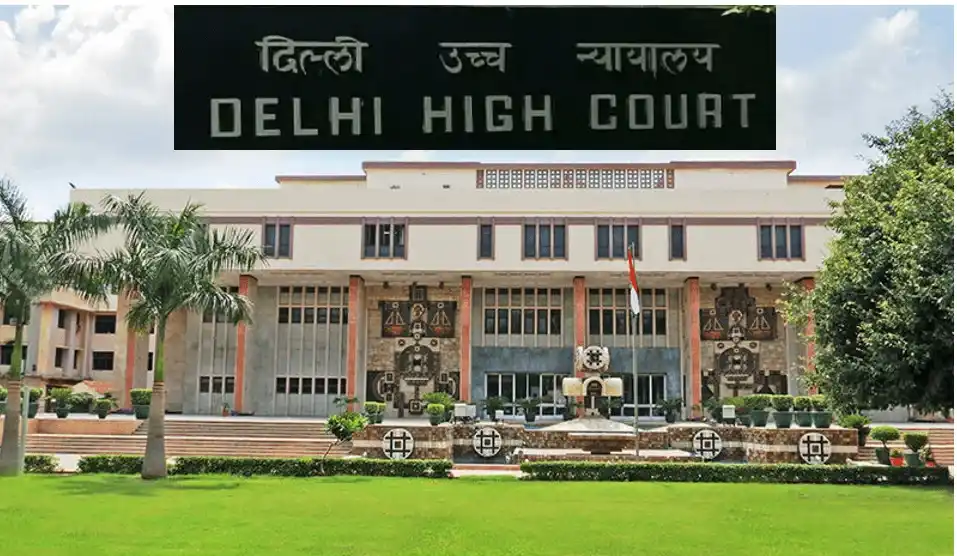
The Delhi High Court has set aside an earlier order granting pension benefits to a former State Bank of India officer for the years he spent under suspension and dismissal following a corruption case. The court ruled that the disputed period cannot be treated as “service on duty” for pension or retiral benefits.
The decision came in an intra-court appeal filed by State Bank of India against its retired officer V. C. Jain, challenging a 2023 judgment of a Single Judge that had directed the bank to count nearly nine years of suspension and dismissal towards pension calculations.
A Division Bench led by Chief Justice Devendra Kumar Upadhyaya delivered the verdict on January 30, 2026, holding that the bank had acted within the rules when it refused to treat the disputed period as qualifying service. The bench agreed with SBI that once Jain accepted reinstatement on specific conditions, he could not later claim pension benefits for that period.
Read Also:- Delhi High Court Refuses Bail in 2020 Transgender Murder Case, Cites Eyewitness Testimony
Jain, then a Scale-III officer of SBI, was posted as Branch Manager at the bank’s Laxmi Nagar branch in 2002. Following a complaint alleging demand of a bribe, the Central Bureau of Investigation registered an FIR. He was arrested and later released on bail.
Soon after, SBI placed him under suspension with effect from September 21, 2002. In July 2005, a trial court convicted him under provisions of the Prevention of Corruption Act and sentenced him to imprisonment. Based on this conviction, the bank dismissed him from service in October 2005, as required under banking laws.
SBI argued that the dismissal was mandatory because banking regulations prohibit continued employment of a person convicted of an offence involving moral turpitude. The bank said it could not be blamed for keeping Jain out of service during that period.
Read Also:- Delhi High Court Rejects Lapse Claim in 1960s Land Acquisition, Says Compensation Was Properly Deposited
Jain, on the other hand, relied on his acquittal by the High Court in December 2010, contending that once the conviction was set aside and he was reinstated, the suspension and dismissal period should count towards pension and retirement benefits.
Chief Justice Upadhyaya noted that Jain’s acquittal was not a “clean acquittal” but one based on benefit of doubt. The bench underlined that service rules clearly distinguish between full exoneration and acquittal on technical or evidentiary grounds.
“The crucial requirement is full exoneration,” the court observed, adding that only in such cases can a suspension period be automatically treated as duty for all purposes.
Read Also:- Delhi High Court Upholds Bar on Forcing Accused to Share Personal Details, Dismisses CBI Plea
The judges also pointed out that when Jain was reinstated in March 2011, SBI had clearly stated that the suspension and dismissal period would not count as service for terminal benefits. Jain accepted these conditions without protest, joined duty, and retired later that year.
Setting aside the Single Judge’s direction, the Division Bench held that the bank’s decision fell within its discretionary powers under service rules. The court ruled that interference under writ jurisdiction was unwarranted, especially when the employee had accepted reinstatement terms and the acquittal was based on benefit of doubt.
Accordingly, the appeal filed by SBI was allowed, and the direction to re-fix Jain’s pension by counting the disputed period as service was quashed. No order on costs was passed.
Case Title: State Bank of India v. V. C. Jain
Case Number: LPA 141/2024
Court: Delhi High Court, New Delhi
Bench: Chief Justice Devendra Kumar Upadhyaya and Justice Tejas Karia
Download Judgment

