

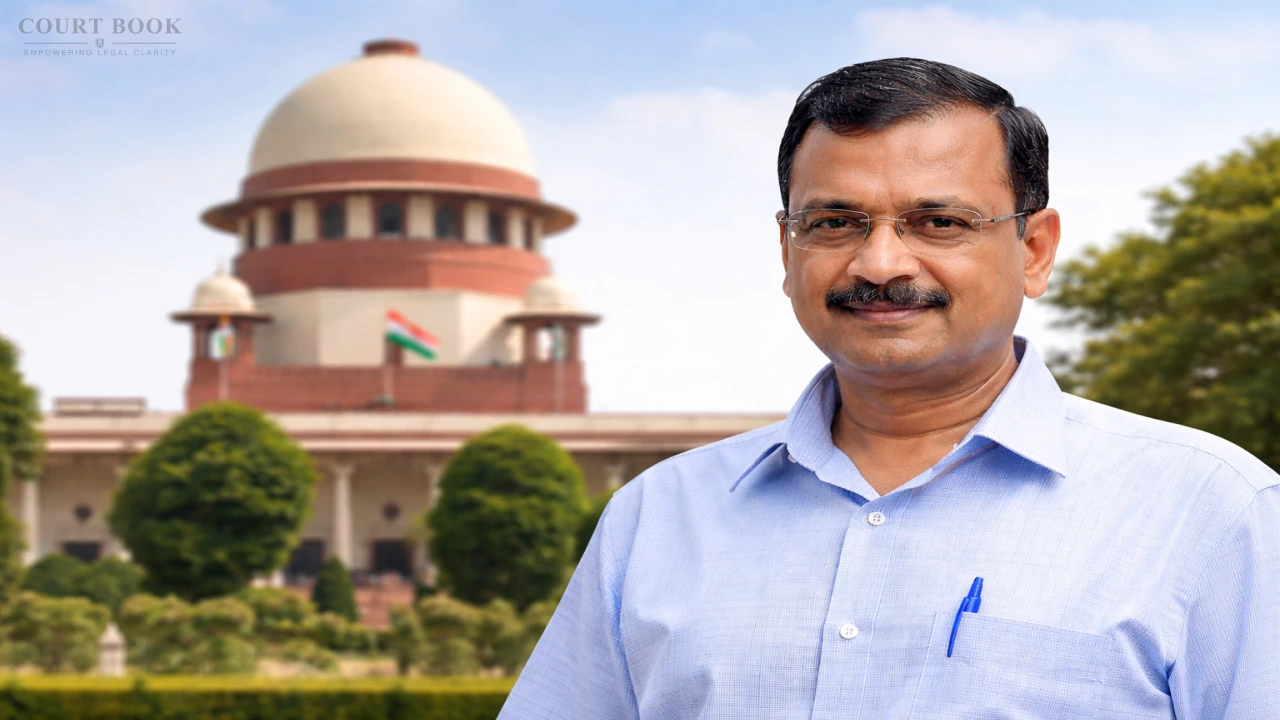
Former Delhi Chief Minister Arvind Kejriwal has moved the Supreme Court of India challenging the decision of the Delhi High Court Chief Justice refusing to transfer the excise policy case from the bench of Justice Swarana Kanta Sharma. The petition raises concerns about judicial impartiality and also questions certain interim observations made during the High Court proceedings.
Background of the Case
The controversy relates to the Delhi excise policy case, in which several political figures and officials were investigated over alleged irregularities in the liquor policy.
Read also:- Delhi High Court Declines Arvind Kejriwal’s Request to Transfer CBI Excise Policy Case
On February 27, a trial court discharged 23 accused persons, including Arvind Kejriwal, former Deputy Chief Minister Manish Sisodia, and K Kavitha. While passing the discharge order, the trial court also made strong remarks regarding the investigation carried out by the Central Bureau of Investigation (CBI).
Following the discharge, the CBI filed a revision petition before the Delhi High Court challenging the trial court’s decision.
The CBI’s challenge to the discharge order came up before Justice Swarana Kanta Sharma of the Delhi High Court.
On March 9, the High Court issued notice in the matter and made a prima facie observation that some remarks made by the trial court appeared erroneous. The Court also stayed the trial court’s direction that had called for an inquiry against the CBI officer who conducted the investigation.
Additionally, the High Court directed the trial court to defer proceedings in the Prevention of Money Laundering Act (PMLA) case, which is based on the CBI’s FIR.
Following these developments, Kejriwal wrote to the Chief Justice of the Delhi High Court requesting that the case be transferred to another bench.
In his representation, Kejriwal expressed apprehension that the case might not receive a hearing marked by neutrality if it continued before the same judge.
He argued that the High Court’s interim order did not clearly explain the basis for restraining the trial court’s directions, particularly when interference with a discharge order is considered an extraordinary step in criminal proceedings.
Kejriwal also pointed out that directions affecting the PMLA proceedings were issued even though the Enforcement Directorate (ED) was not a party before the High Court.
Another ground raised was that the same judge had earlier handled matters related to the excise policy and had expressed detailed prima facie views on the underlying facts. According to Kejriwal, several such earlier decisions had later been overturned or reconsidered by the Supreme Court.
The Chief Justice of the Delhi High Court, Justice Devendra Kumar Upadhyaya, declined the request to transfer the case.
In a communication issued through the Registrar General, the Chief Justice stated that the case had been assigned according to the existing roster system and that there was no administrative reason to transfer it to another bench. The communication also clarified that any decision regarding recusal must be taken by the judge hearing the case.
Following this refusal, Kejriwal has now approached the Supreme Court through a writ petition under Article 32 of the Constitution, challenging both the refusal to transfer the case and certain observations made by the High Court.


