

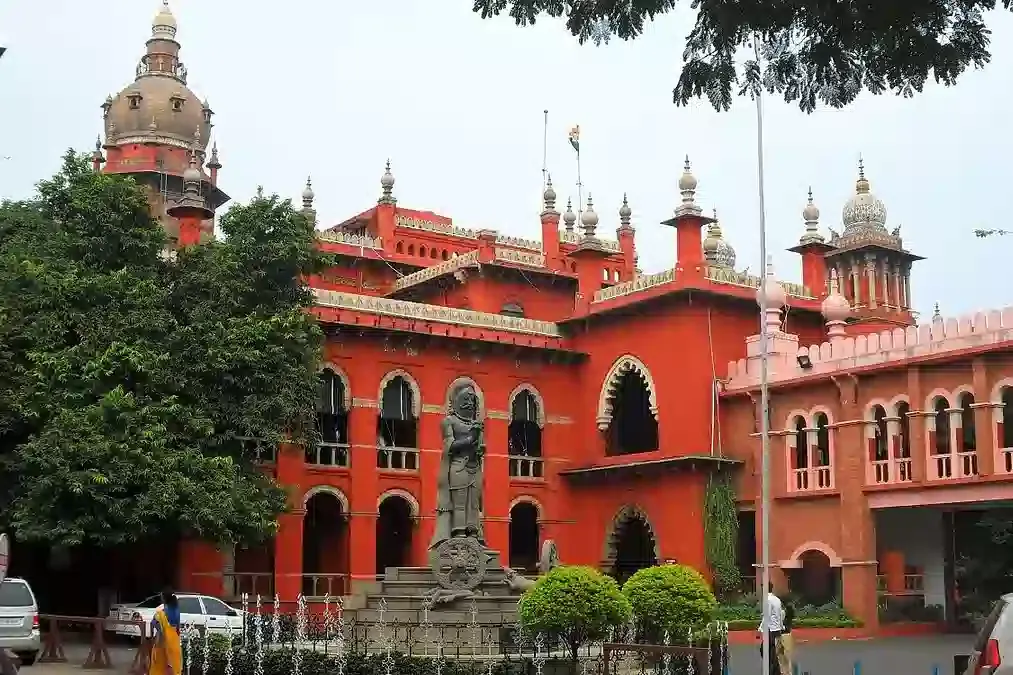
The Madurai Bench of the Madras High Court has upheld the conviction and life sentence awarded to a former engineering student in connection with the death of a college student inside a classroom in Karur nearly a decade ago.
A Division Bench comprising Justice N. Anand Venkatesh and Justice K.K. Ramakrishnan dismissed the criminal appeal filed against the trial court's judgment, finding no reason to interfere with the conviction recorded by the Fast Track Mahila Court in Karur.
Background of the Case
According to the prosecution, the incident took place on August 30, 2016, inside a classroom at Karur College of Engineering.
The deceased, a third-year engineering student, and the accused had earlier studied in the same course. The prosecution alleged that differences had developed between them and that the accused later entered the classroom during college hours and attacked the student with a wooden log. An assistant professor who attempted to intervene also suffered injuries.
The injured student was rushed to hospital but later died due to severe head injuries.
Following investigation, police filed a chargesheet and the trial court convicted the accused under various provisions of the Indian Penal Code, including murder, criminal trespass and causing hurt. He was sentenced to life imprisonment, prompting the present appeal.
The defence questioned the identity of the accused and argued that no test identification parade had been conducted during the investigation.
Senior counsel appearing for the appellant contended that the principal eyewitness, an assistant professor, had joined the college only weeks before the incident and did not know the accused personally before the occurrence.
The State opposed the appeal, arguing that the professor was himself an injured witness and had clearly identified the accused in court. The prosecution further submitted that the witness's account was supported by medical evidence and other surrounding circumstances.
Court's Observations
The High Court examined the evidence in detail and placed significant reliance on the testimony of the injured professor.
Addressing the argument regarding identification, the bench observed that a test identification parade is only an investigative aid and is not mandatory in every case.
“The Court must only see if such identification by the witness is otherwise trustworthy and reliable,” the judges noted.
The bench said an injured witness who directly experiences a violent incident is unlikely to forget the face of the assailant. Referring to Supreme Court precedents on human memory and eyewitness identification, the court observed that traumatic events often leave a lasting impression.
“A person who encounters such an extreme experience is not likely to forget the face of the assailant even for a life time,” the bench said.
The court also found that the medical evidence fully supported the prosecution's version regarding the nature of injuries suffered by the deceased.
While noting certain shortcomings in the investigation, including issues surrounding recovery of the alleged weapon, the judges held that such lapses could not outweigh the consistent and credible evidence available on record.
The bench further expressed concern over several student witnesses turning hostile during the trial, observing that their conduct had weakened the effort to establish the truth before the court.
Decision
Concluding that the prosecution had established its case beyond reasonable doubt, the Madras High Court upheld the findings of the trial court.
The bench dismissed the criminal appeal and confirmed the conviction and life sentence imposed by the Additional District and Sessions Judge, Fast Track Mahila Court, Karur. The trial court was directed to take necessary steps to secure the presence of the accused for serving the remaining period of sentence.
Case Details:
Case Title: Udayakumar vs State
Case Number: Crl. A. (MD) No. 301 of 2023
Judges: Justice N. Anand Venkatesh and Justice K.K. Ramakrishna
Decision Date: June 15, 2026


