

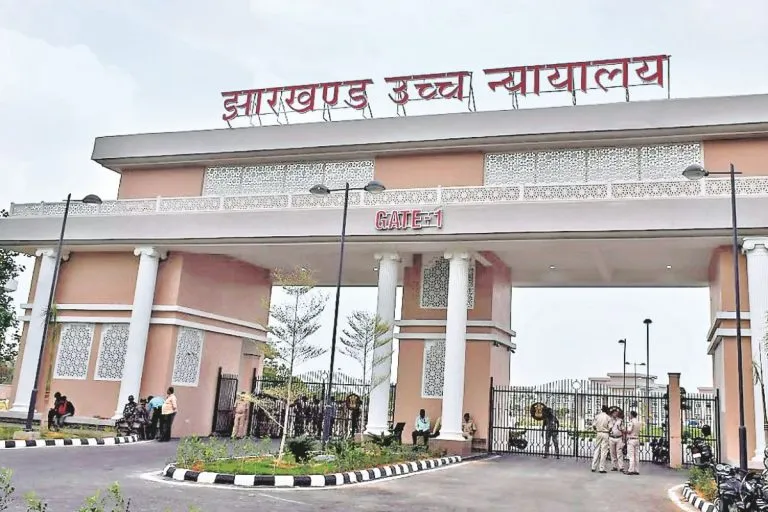
In a significant ruling on pension rights and due process, the Jharkhand High Court has dismissed an appeal filed by the State, affirming that a retired government employee’s pension cannot be reduced without proper departmental proceedings and proof of misconduct.
Background of the Case
The case arose from a dispute involving Brajeshwar Singh, a retired Junior Engineer from the Water Resources Department. After his retirement in December 2016, the State government imposed a penalty of 15% deduction from his pension for five years, citing alleged irregularities in irrigation projects executed during 2003–04.
These allegations stemmed from inquiry reports suggesting financial and execution lapses in microlift irrigation schemes in Bokaro district. Singh was issued show-cause notices before and after retirement, following which the pension cut order was passed in September 2017.
Challenging this, Singh approached the High Court. A Single Judge bench had earlier set aside the punishment in 2024, prompting the State to file the present appeal.
The State contended that departmental proceedings had indeed been initiated before Singh’s retirement and that the punishment was based on inquiry findings indicating irregularities and financial misconduct.
It was argued that the employee’s service was not “thoroughly satisfactory,” justifying action under the Jharkhand Pension Rules, 2000.
On the other hand, Singh’s counsel argued that no proper departmental proceeding was conducted. There was no formal charge-sheet, no full inquiry, and no adequate opportunity for defense.
It was also highlighted that the alleged incidents dated back over a decade, raising questions about limitation and procedural fairness.
Read also:- Suspicion Alone Not Abetment: Uttarakhand HC Acquits Man in Wife’s Suicide Case
The Division Bench, led by Chief Justice M.S. Sonak and Justice Rajesh Shankar, closely examined the legal framework governing pension reduction.
The court clarified that pension can only be reduced under two conditions:
1. If the service record is not “thoroughly satisfactory,” or
2. If grave misconduct is proved through proper proceedings.
“The authority must examine the entire service record,” the bench observed, adding that a single instance of alleged irregularity cannot justify branding the entire service as unsatisfactory.
On the second condition, the court stressed that allegations alone are not enough.
“Mere allegation of irregularity is not sufficient… it must be proved in a departmental or judicial proceeding,” the bench noted.
Read also:- Wife Found With Lover, Husband Loses Self-Control: Gujarat High Court Upholds Culpable Homicide Verdict
The judges found that no full-fledged departmental inquiry was conducted. There was no charge-sheet, no appointed inquiry officer, and no structured hearing process.
Concluding that the mandatory legal requirements were not met, the court held that the pension cut order was unsustainable.
“The condition precedent for exercising power under the pension rules was not fulfilled,” the bench stated, agreeing with the earlier Single Judge ruling.
Accordingly, the High Court dismissed the State’s appeal, upholding the quashing of the pension deduction order.
Case Details
Case Title: State of Jharkhand & Ors. v. Brajeshwar Singh
Case Number: L.P.A. No. 102 of 2025
Judge: Chief Justice M.S. Sonak & Justice Rajesh Shankar
Decision Date: 19 March 2026
Counsels:
• For Appellants: Mr. Anish Kr. Mishra
• For Respondent: Mr. Manoj Prasad, Ms. Jyoti Kumari


