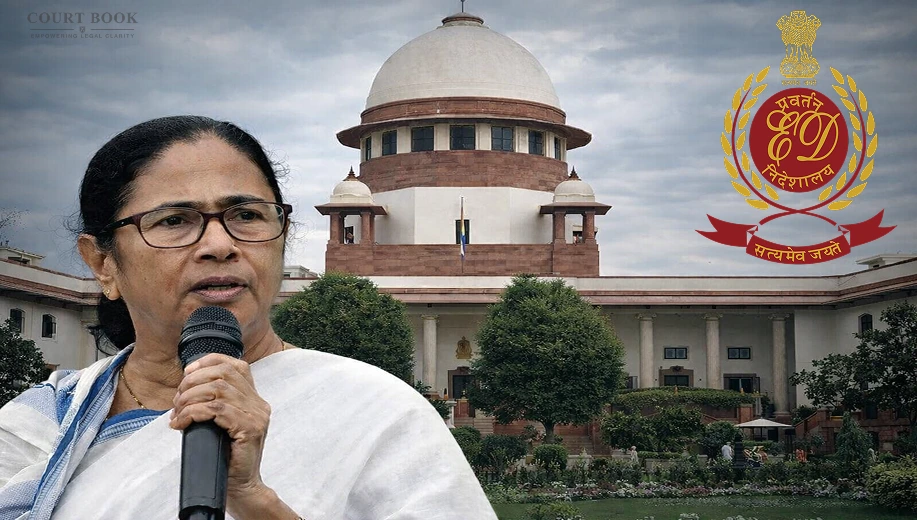
The Supreme Court on Thursday 15 January stepped into a politically sensitive dispute between the Enforcement Directorate (ED) and the West Bengal government, issuing notice on petitions that accuse Chief Minister Mamata Banerjee and senior state police officials of obstructing a lawful central agency search. The case arises from a January operation at the office of political consultancy firm I-PAC and the residence of its director, Prateek Jain.
A Bench of Justices P.K. Mishra and Vipul M. Pancholi said the allegations raised “larger questions” about the independence of investigations by central agencies and the limits of state interference issues that, the court felt, required scrutiny at the highest level.
Background of the Case
According to the ED, its officers were conducting searches under the Prevention of Money Laundering Act (PMLA) on January 8 in connection with an alleged coal scam. The agency claims that during the operation, Chief Minister Mamata Banerjee, accompanied by the Director General of Police and the Kolkata Police Commissioner, entered the premises and interfered with the search.
Read also:- Avaniyapuram Jallikattu Will Be State-Run, Not by Private Committee: Madras High Court Rules
The ED has asked the Supreme Court to order a Central Bureau of Investigation (CBI) probe into the alleged conduct of the Chief Minister and state police officials. It has also sought protection for its officers, alleging threats to their personal liberty and safety.
ED’s Allegations Before the Court
Appearing for the ED, Solicitor General Tushar Mehta described the incident as “shocking” and argued that it reflected a pattern of interference with central investigations in the state. He told the court that the Chief Minister and senior officers entered the premises despite being requested not to disrupt the search.
“This is an offence of theft,” Mehta alleged, claiming that digital devices, documents, and even an ED officer’s mobile phone were taken away. He warned that such actions would demoralise officers and make it difficult for statutory authorities to discharge their duties fearlessly.
Read also:- Supreme Court Stays SASTRA Eviction Order, Tells State Not to Treat Campus Land Dispute as a Prestige Issue
The ED further pointed out that several FIRs were registered against its officers after the incident and alleged that CCTV footage from the premises was removed. According to the agency, these developments showed why an independent probe by a central agency was necessary.
Additional Solicitor General S.V. Raju supported the plea, arguing that the admitted facts disclosed cognisable offences. He submitted that when allegations involve the Chief Minister and top police officials, it would be unrealistic to expect the state police to conduct a fair investigation.
Defence by the State and Other Respondents
Senior Advocates Kapil Sibal and Abhishek Manu Singhvi, representing the respondents, strongly opposed the petitions. They questioned their maintainability and accused the ED of forum shopping, pointing out that similar issues were already pending before the Calcutta High Court.
Read also:- Sex on Promise of Marriage Not a ‘Private Dispute’: Allahabad High Court Lets Trial Continue
Sibal argued that Mamata Banerjee had gone to the premises not as Chief Minister but as the Chairperson of the Trinamool Congress, after receiving information that unknown persons had entered a location handling sensitive election-related data. Singhvi went further, saying the ED’s own panchnama contradicted its claims of seizure. “Either the panchnama is lying, or the ED petition is lying,” he remarked.
The State also raised concerns about the timing of the search, alleging that it took place during the election season and was aimed at accessing political party data. It was argued that the ED should have pursued remedies before the High Court under Article 226 instead of invoking the Supreme Court’s jurisdiction under Article 32.
Court’s Observations
The Bench expressed unease over what it described as repeated disruptions affecting investigative agencies and even constitutional courts. Referring to earlier observations made by the Calcutta High Court in related matters, Justice Mishra noted that such situations could not be allowed to become routine.
Read also:- Allahabad HC Quashes Summoning in Marital Dispute, Flags Police Lapses in Non-Cognizable FIR Handling
Recording the ED’s submissions, the court noted that the agency was probing an alleged scam involving more than ₹2,700 crore and that intelligence inputs had linked proceeds of crime to I-PAC’s operations. It also took note of the allegation that, despite valid authorisation, ED officers were obstructed and materials collected during the search were taken away.
Taking a prima facie view, the Bench observed, “If such issues are allowed to remain undecided, it may lead to a situation of lawlessness.” At the same time, the court clarified that central agencies have no authority to interfere with legitimate election-related activities of political parties.
Decision
Concluding the hearing, the Supreme Court issued notice to the respondents and called for their replies.
The matter will be heard further after responses are filed, on February 3.
Case Title: Directorate of Enforcement v. The State of West Bengal





 chief. Eknath Shinde – Shiv Sena leader-300x169.webp)
-300x169.webp)