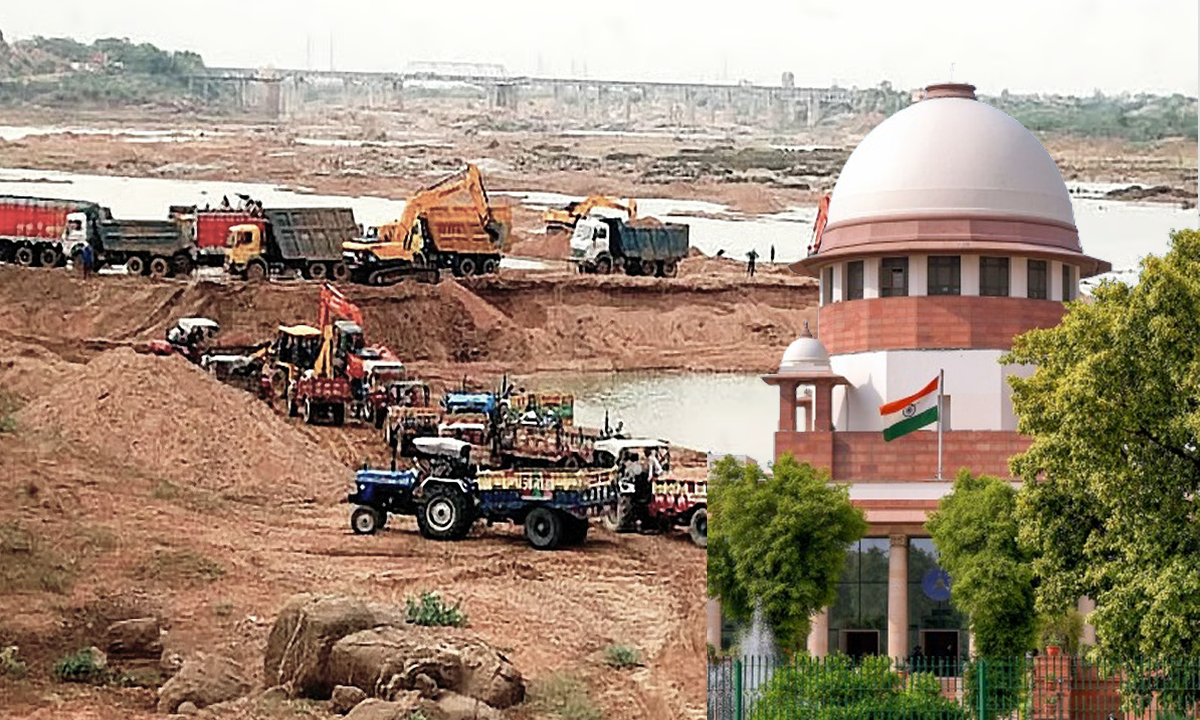
The Supreme Court directed Madhya Pradesh, Rajasthan and Uttar Pradesh to immediately tighten surveillance and enforcement against illegal sand mining in the National Chambal Gharial Sanctuary. The Court ordered installation of CCTV cameras, GPS tracking of mining vehicles, joint patrol teams and swift prosecution of offenders after taking note of recent violent incidents, including the deaths of two forest guards.
Background of the Case
The matter arose from a suo motu petition initiated by the Supreme Court after reports of large-scale illegal sand mining inside the protected Chambal sanctuary, a key habitat of the endangered gharial and other aquatic wildlife.
Earlier hearings had already raised concerns over ecological damage, destruction of wildlife habitat and weak enforcement by state authorities. The Court had also stayed a Rajasthan notification linked to the sanctuary and sought reports from state governments and the Central Empowered Committee.
During the hearing, the Court was informed about the killing of forest guard Harikesh Gurjar in Morena, Madhya Pradesh, on April 8, 2026. According to the application placed before the bench, he was allegedly run over by a tractor-trolley carrying illegally mined sand while on patrol duty.
Read also:- Bombay High Court Quashes FIR Against Doctor Over Alleged COVID Rule Violation, Finds No Prima Facie Offence
The Court was also told about another forest guard, Jitendra Singh Shekhawat, who died in Rajasthan in January after being seriously injured during an attempt to stop a vehicle allegedly involved in illegal mining.
Another serious issue flagged was mining activity near pillars of an inter-state bridge on National Highway-44 connecting Madhya Pradesh and Rajasthan, raising fears over structural safety.
The bench of Justice Vikram Nath and Justice Sandeep Mehta said illegal mining has repeatedly caused severe environmental damage by disturbing river systems, harming biodiversity and threatening groundwater reserves.
The Court said it could not remain a “silent spectator” when mining was continuing inside a wildlife sanctuary. It noted a “prima facie lackadaisical approach” by the concerned states.
In a sharp remark, the bench observed that authorities appeared to have
“abdicated, if not altogether abandoned, their statutory and constitutional responsibilities.”
The Court also expressed concern over claims that forest officials lacked proper equipment to deal with organized mining groups. It said the State cannot plead helplessness when lives, law and the environment are at stake.
Read aslo:- Supreme Court Clarifies Arbitration Law: ‘Can’ in Contract Clause Does Not Force Parties Into Arbitration
Using powers under Article 142 of the Constitution, the Court passed several interim directions, including:
• High-resolution Wi-Fi enabled CCTV cameras on vulnerable mining routes and river stretches
• Live monitoring under district police chiefs and forest officers
• Pilot GPS tracking for mining vehicles and machinery in Morena and Dholpur districts
• Immediate seizure of vehicles involved in illegal mining
• Environmental compensation under the “Polluter Pays” principle
• Joint police-forest patrol teams with modern equipment and arms
• Uniform inter-state Standard Operating Procedure for crackdown operations
• Personal accountability of officers for negligence or non-compliance
The Supreme Court directed Madhya Pradesh, Rajasthan and Uttar Pradesh to file compliance affidavits before the next hearing. It warned that if effective steps are not taken, the Court may consider stronger measures, including deployment of paramilitary forces, a complete ban on sand mining in Madhya Pradesh and Rajasthan, and heavy penalties on the states.
The main matter will next be heard on May 11, 2026.
Case Details
Case Title: Illegal Sand Mining in the National Chambal Sanctuary and Threat to Endangered Aquatic Wildlife
Case Number: Suo Motu Writ Petition (Civil) No. 2 of 2026
Judges: Justice Vikram Nath and Justice Sandeep Mehta
Decision Date: April 17, 2026
Download Judgment








-300x169.webp)
-300x169.webp)