

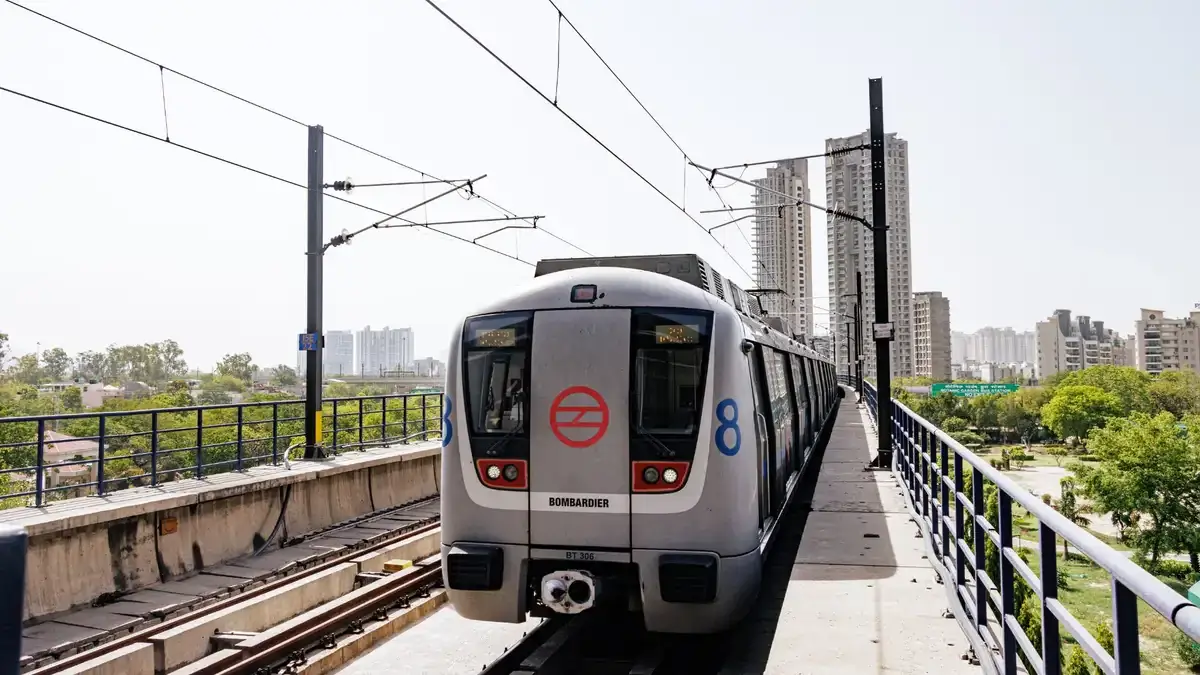
The Delhi High Court on Wednesday set aside an arbitral award in a long-running dispute between an advertising firm and the Delhi Metro Rail Corporation, holding that the arbitrator failed to decide the very issue at the heart of the case. Justice Jasmeet Singh, after hearing detailed arguments, found that the award lacked clear reasoning and skipped over whether the Metro itself had breached the contract.
हिंदी में पढ़ें
Background
The case arose from a 2010 contract under which M/s Traffic Media (India) Pvt. Ltd. was granted advertising rights inside certain Delhi Metro trains. The agreement covered trains on two corridors-Inderlok–Mundka (Line-5) and Central Secretariat–Badarpur (Line-6).
Read also:- Unnao Rape Case Reaches Supreme Court Again as Plea Challenges Delhi High Court’s Suspension of Kuldeep Sengar's Life Sentence
Trouble started when Traffic Media objected to being asked to take over trains meant for Line-6 at a time when that corridor was not operational. The company argued that it could not commercially use those trains and that forcing them onto Line-5 disrupted its business model. Despite repeated objections, the Delhi Metro Rail Corporation terminated the contract and retained licence fees and security deposits already paid.
An arbitrator later rejected most of Traffic Media’s claims, including refund of deposits, while also dismissing DMRC’s counter-claims. Unhappy with this outcome, Traffic Media approached the Delhi High Court under Section 34 of the Arbitration Act.
Read also:- Calcutta High Court Rules MSTC Can Recover Gratuity Losses Under CDA Rules, Sets Aside Single Judge Order in Senior CMD Dispute
Court’s Observations
Justice Singh noted that although the arbitrator framed several issues-ranging from contract validity to breach and refund-there was no real discussion on them. “The award records conclusions but does not disclose the reasoning or thought process leading to those conclusions,” the court observed.
The judge pointed out that the arbitrator himself had held it was unreasonable to force trains earmarked for Line-6 onto Line-5. Yet, strangely, the award never decided whether this conduct amounted to a breach by DMRC. That omission, the court said, undermined every other finding.
The bench observed that a valid contract does not automatically justify keeping money paid under it. Whether licence fees and security deposits could be retained depended on who breached the agreement and how. “Without a finding on breach, the arbitrator could not have rejected the claim for refund in such a mechanical manner,” the court remarked.
Read also:- Allahabad High Court dismisses accused's revision plea, reiterates no challenge lies against magistrate's FIR order under Section 156(3) CrPC
Decision
Concluding that the arbitrator failed to decide the foundational issue of breach and offered no intelligible reasons, the Delhi High Court set aside the entire arbitral award. The petition filed by Traffic Media was allowed, and all pending applications were disposed of accordingly.
Case Title: M/s Traffic Media (India) Pvt. Ltd. vs Delhi Metro Rail Corporation
Case No.: O.M.P. 1277/2013
Case Type: Petition under Section 34, Arbitration and Conciliation Act, 1996
Decision Date: 24 December 2025


