

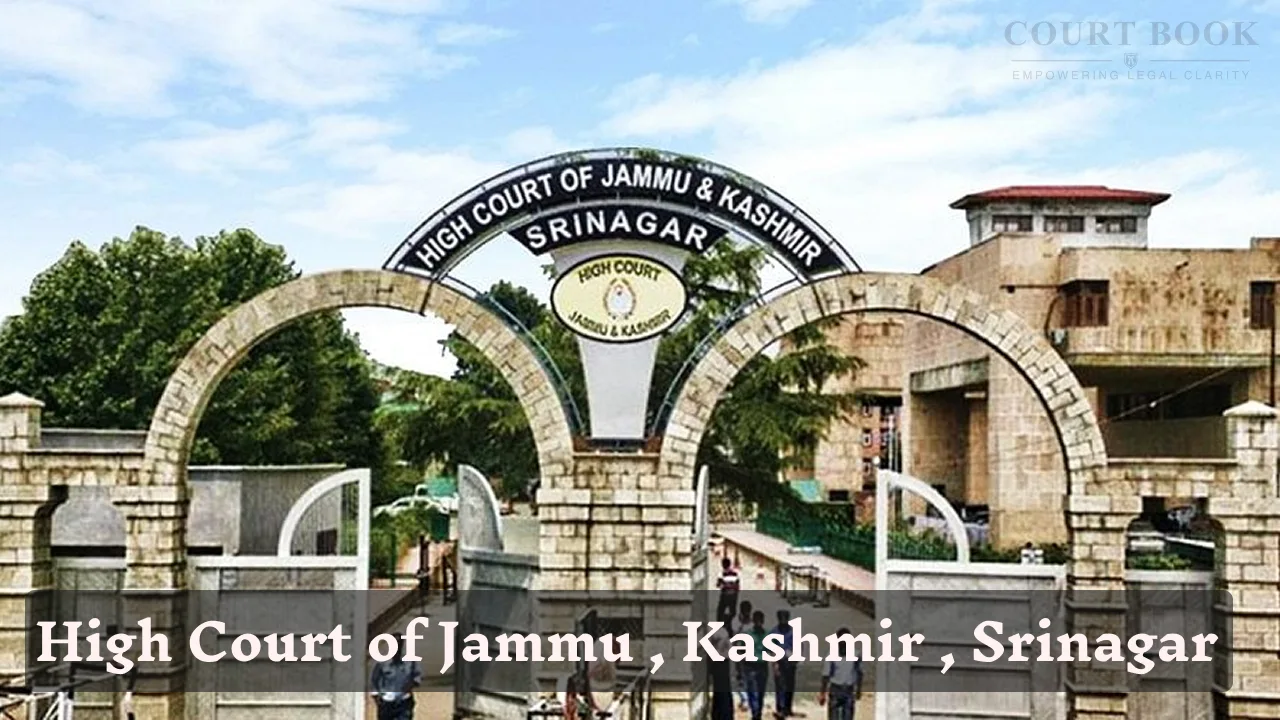
The Srinagar courtroom was quiet but tense as the High Court of Jammu & Kashmir and Ladakh delivered its verdict on a long-pending demand raised by employees and retirees of J&K Sainik School, Mansbal. After years of hope, files, and committee meetings, the court finally settled the issue: pension cannot be granted merely on expectations or assurances unless service rules clearly provide for it.
हिंदी में पढ़ें
Justice Sanjay Dhar pronounced the judgment, dismissing two connected writ petitions filed by 59 serving employees and one retired staff member, Abdul Majeed Parray.
Read also:-Supreme Court Settles Decades-Old Faridabad Land Auction Dispute, Clarifies Rights of Buyers During
Background
The petitioners had approached the High Court seeking pensionary benefits on retirement, similar to those available to government employees and staff of other Sainik Schools across India. They argued that the Mansbal school, set up by the erstwhile J&K government in 1980, is fully funded and controlled by the Union Territory administration.
Over the years, the demand for pension had travelled through board meetings, executive committees, and even received what the employees described as “approval in principle” from a former Chief Minister during a school function in 2005. Despite this, no pension scheme was ever implemented. Instead, employees continued under a Contributory Provident Fund (CPF) system.
Read also:-Supreme Court Clarifies Limits on Foreign Banks’ Head Office Expense Deductions, Overrules Long
Court’s Observations
The court examined the entire paper trail, from board resolutions to finance department communications. It noted that while discussions on pension happened repeatedly, no final approval was ever granted by the Board of Governors, which is the school’s highest decision-making body.
Justice Dhar observed that the Chief Minister, even as Chairman of the Board, could not unilaterally enforce a pension scheme. “Unless a decision is approved by the Board of Governors, the same cannot be put into operation,” the bench observed.
Crucially, the court explained that pension is not an automatic or fundamental right. It flows only from service rules. In this case, the school’s own regulations clearly provide CPF, gratuity, and other benefits, but make no mention of pension. “The existence of a legal right is the foundation for issuing a writ,” the court noted, adding that no such enforceable right existed here.
The argument of parity with government employees and other Sainik Schools was also rejected. The court pointed out that institutions may look similar from outside, but their funding structure, controlling authority, and service conditions differ.
Read also:-Supreme Court restores trial court decree in Kerala land deal dispute, rejects High Court’s remand
Decision
In the end, the High Court dismissed both writ petitions, holding that employees of J&K Sainik School, Mansbal cannot claim pension in the absence of a specific provision in their service rules. However, the court clarified that the Board of Governors remains free to introduce a pension scheme in future, if it so decides.
Case Title: Abdul Majeed Parray & Ors. vs Union Territory of Jammu & Kashmir & Ors.
Case No.: WP(C) No. 616/2021 c/w WP(C) No. 391/2021
Case Type: Writ Petition (Service – Pensionary Benefits)
Decision Date: 11 December 2025
Download Judgment

