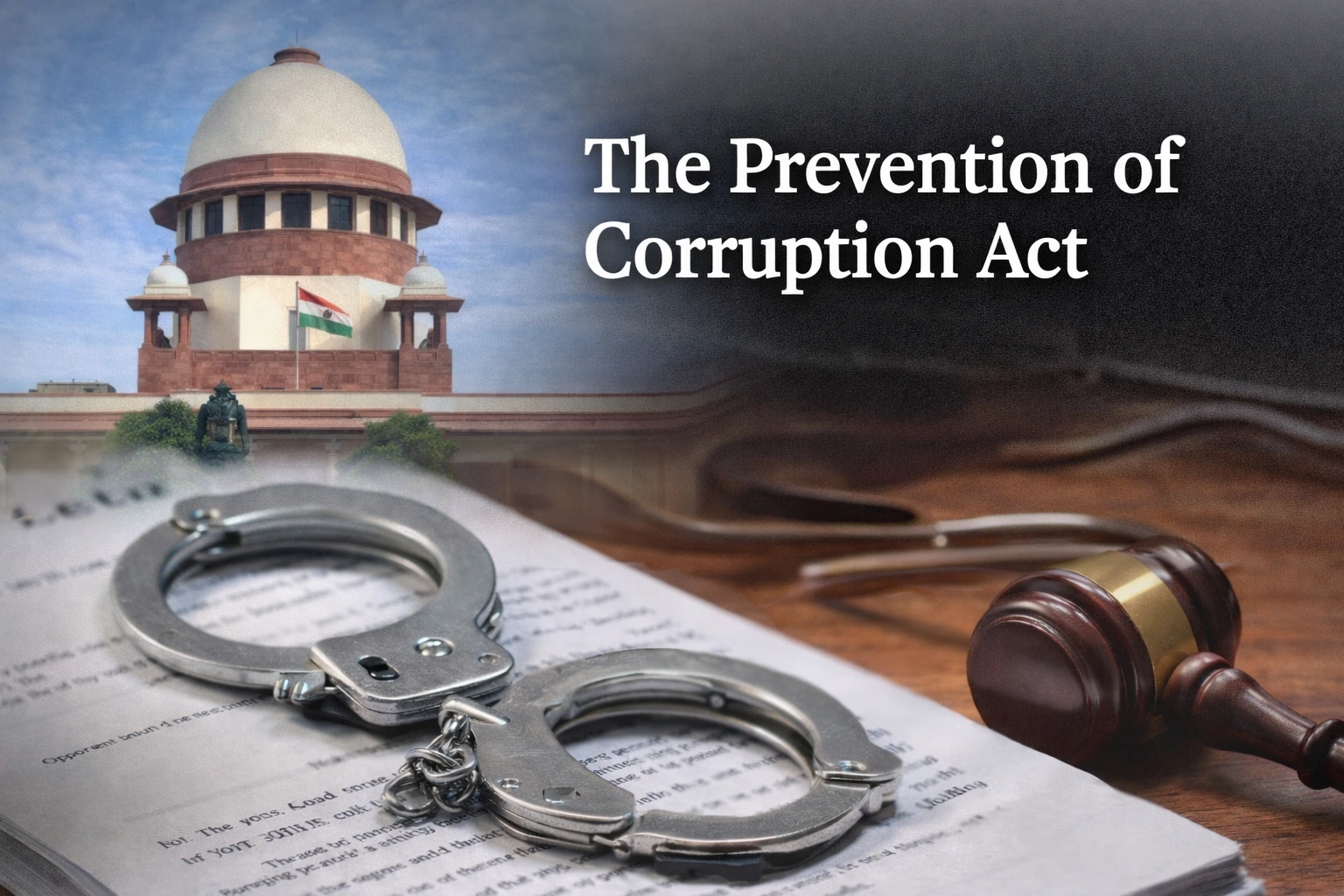
The Supreme Court on January 19, 2026, dismissed a petition filed by Nawal Kishore Meena, a Central Government employee, who had challenged the jurisdiction of the Rajasthan Anti-Corruption Bureau (ACB) to register and investigate a corruption case against him under the Prevention of Corruption Act, 1988.
A Bench of Justice J.B. Pardiwala and Justice Satish Chandra Sharma found no legal error in the Rajasthan High Court’s decision and refused to interfere with it.
Background of the Case
The matter arose from an order of the Rajasthan High Court at Jaipur dated October 3, 2025, passed in SBCRMP No. 5157/2024. The petitioner had argued that since he was serving under the Central Government, only the Central Bureau of Investigation (CBI) could investigate offences under the Prevention of Corruption Act.
Before the High Court, two key legal questions were raised:
1. Whether the Rajasthan ACB had the authority to register and investigate a corruption case against a Central Government employee within the State’s territorial jurisdiction.
2. Whether a charge-sheet filed by the ACB without approval or consent of the CBI could be treated as valid in law.
The High Court had answered both questions against the petitioner, holding that the ACB could proceed even if the accused was a Central Government employee.
Court Observations
Hearing the Special Leave Petition (Crl.) No. 492/2026, the Supreme Court agreed with the High Court’s reasoning and made it clear that corruption offences do not become “CBI-only” cases merely because the accused works for the Centre.
In a significant observation, the Bench noted that the High Court had taken the “correct view” in rejecting the argument that only the CBI could have initiated prosecution.
The Court explained that the Delhi Special Police Establishment Act (DSPE Act), under which the CBI functions, does not automatically take away the powers of the regular police or State agencies.
Referring to the Criminal Procedure Code (CrPC), the Bench pointed out that Section 156 allows the officer in charge of a police station to investigate cognizable offences, and such investigation cannot be questioned merely on the ground of lack of power at a later stage.
“The Criminal Procedure Code is the parent statute,” the Bench observed in effect, noting that unless a special law clearly provides a different procedure, CrPC provisions continue to apply.
The Supreme Court also discussed Section 17 of the Prevention of Corruption Act, which deals with who can investigate offences under the Act. The Court underlined that the PC Act does not create an exclusive investigation zone for the CBI.
Read also:- Allahabad High Court Orders Special Exam for BSc Student Denied Admit Card Due to Portal Error
Instead, what Section 17 requires is that the investigation must be conducted by a police officer of a specified rank, depending on the area and the agency involved.
The Bench noted that State anti-corruption wings such as ACB/VACB are part of the State police system and can investigate PC Act offences, including those involving Central Government employees posted within the State.
The Court clarified that CBI’s role in investigating corruption cases involving Central Government employees is often based on administrative arrangements and convenience, not because State agencies are legally barred.
To support its view, the Bench referred to the landmark decision in A.C. Sharma v. Delhi Administration (1973). In that case, the accused had argued that only the DSPE (CBI) could investigate him because he was a Central Government employee. The Supreme Court had rejected that argument and held that the DSPE Act is “permissive,” meaning it empowers the DSPE/CBI but does not strip regular police of their jurisdiction.
The Court also noted that High Courts in Madhya Pradesh and Andhra Pradesh had taken similar positions, recognising the State police’s authority to investigate corruption offences against Central Government employees posted in the State.
Read also:- Unrecognised Madarsa Cannot Be Shut Down for Lack of Approval Alone: Allahabad High Court
Decision
Concluding the hearing, the Supreme Court held that it found “no error, not to speak of any error of law” in the High Court’s judgment.
Accordingly, the Bench dismissed the Special Leave Petition and disposed of all pending applications.
Case Title: Nawal Kishore Meena @ N.K Meena v. State of Rajasthan
Case No.: SLP (Crl.) No. 492/2026
Decision Date: 19 January 2026
Download order



 chief. Eknath Shinde – Shiv Sena leader-300x169.webp)
-300x169.webp)