

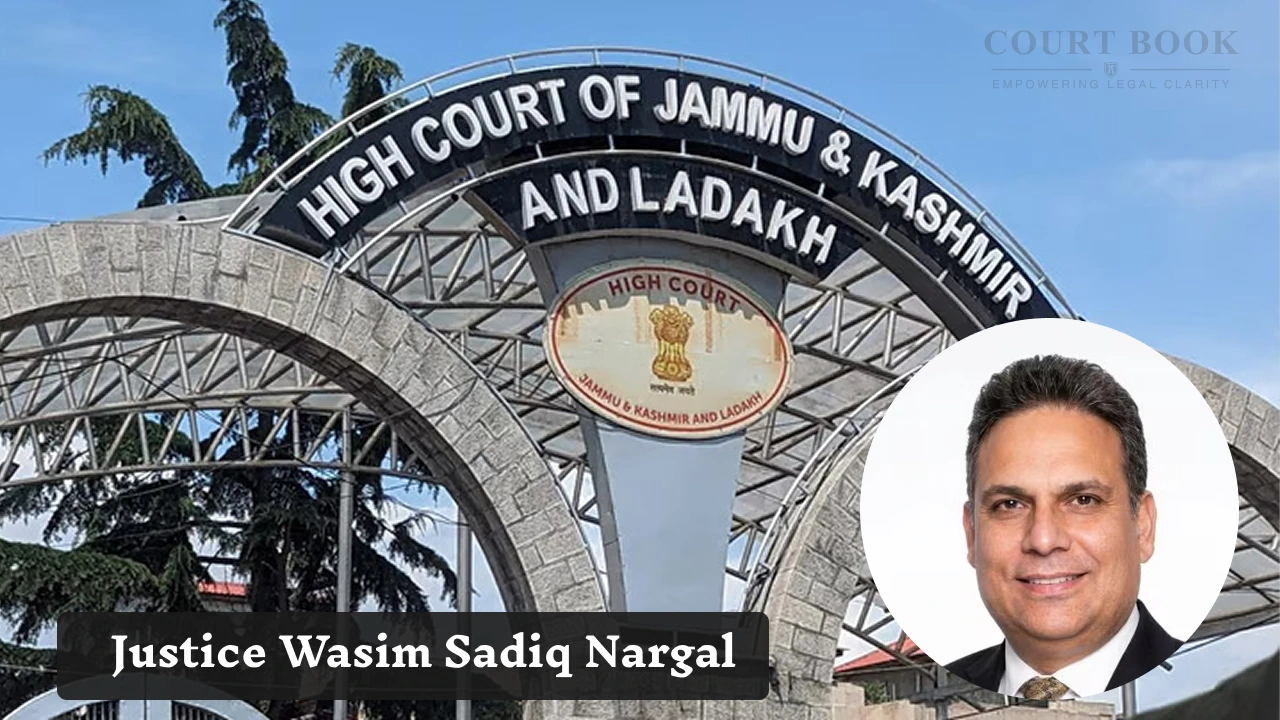
The High Court of Jammu & Kashmir and Ladakh has upheld orders directing a landowner from Anantnag to refund more than ₹2.61 crore received as excess compensation in a National Highway land acquisition case. The Court held that retaining public money beyond lawful entitlement would amount to “unjust enrichment” and cannot be permitted in law.
Justice Wasim Sadiq Nargal dismissed the petition filed by Ali Mohammad Dar, who had challenged orders of the Principal District Judge, Anantnag directing recovery of the excess amount along with 6% interest.
Background of the Case
The dispute arose from acquisition of nearly 6 kanals and 2 marlas of land along with structures at Sangam, Bijbehara in Anantnag district for the Srinagar–Jammu National Highway widening project.
An award passed in 2014 had granted compensation to the petitioner for the acquired land, structures, reinstallation of a petrol outlet, and loss of earnings. The award later attained finality after challenges before the High Court and the Supreme Court failed.
Subsequently, the National Highways Authority of India moved an application before the trial court claiming that an excess amount had been released to the petitioner due to duplication in disbursement calculations. The trial court accepted the plea and directed recovery of ₹2,61,34,972 with interest at 6% per annum.
The petitioner then approached the High Court under Article 227 of the Constitution.
The High Court said the trial court had only exercised its inherent powers under Section 151 of the Code of Civil Procedure and Section 17-B of the J&K Land Acquisition Act to correct an arithmetical mistake.
“The exercise undertaken by the Court below is confined to giving effect to the award in its true spirit by preventing duplication of payment and ensuring lawful adjustment,” the bench observed.
Rejecting the petitioner’s argument that the court had become “functus officio” after the award attained finality, Justice Nargal clarified that inherent powers can still be used to prevent abuse of process and secure justice.
The Court also held that compensation in land acquisition matters includes structures and assets attached to the land, and amounts previously received by the claimant could legally be adjusted against the final compensation.
Relying on Supreme Court precedents on restitution and unjust enrichment, the High Court said no person can retain money that is not legally due to them.
“The doctrine of unjust enrichment mandates that no person can be allowed to retain a benefit which is not legally due to him,” the Court stated.
The bench further held that payment of interest on the excess amount was justified because the petitioner had enjoyed the benefit of the money for a considerable period.
The High Court upheld both orders passed by the Principal District Judge, Anantnag, and directed the petitioner to deposit the excess amount along with 6% interest within one month. It also clarified that failure to comply would permit recovery as arrears under the Land Revenue Act.
The petition was ultimately dismissed for lack of merit.
Case Details
Case Title: Ali Mohammad Dar v. National Highways Authority of India & Anr.
Case Number: CM(M) No. 149/2026
Judge: Justice Wasim Sadiq Nargal
Decision Date: 07 May 2026
Download Judgment

