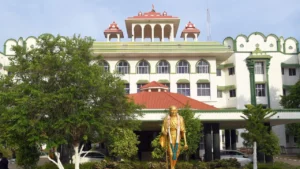
The Madras High Court on Tuesday (January 20, 2026) reserved its verdict in a closely watched censorship dispute involving actor-politician Vijay’s Tamil film Jana Nayagan, after hearing detailed arguments from the Central Board of Film Certification (CBFC) and the film’s producers.
A Division Bench of Chief Justice Manindra Mohan Shrivastava and Justice G Arul Murugan kept the matter for orders after a nearly three-hour-long hearing, with both sides sparring over whether the CBFC could send the film for a fresh review after its regional panel had already recommended a UA certificate.
Background of the Case
The dispute began after producer KVN Productions LLP applied for certification on December 18, 2025.
According to the producers, the CBFC’s Examining Committee, through a communication dated December 22, 2025, recommended certification under ‘UA 16+’, citing factors such as violence, fight sequences, gory visuals, and brief religious references.
The committee also suggested certain cuts and modifications. The producers said they complied, resubmitted the revised version, and the changes were verified by December 29, 2025.
However, the situation took a sharp turn when the producers received an email on January 5, stating that the film was being referred to a Revising Committee under the certification rules, reportedly due to a complaint raising concerns about the portrayal of defence forces and possible hurt to religious sentiments.
This led the producers to move the High Court in writ jurisdiction. A single judge ruled in their favour and directed CBFC to grant the UA certificate. That order was later stayed by the Division Bench, which noted that the Central government had not been given adequate time to file its response.
Appearing for CBFC, Additional Solicitor General ARL Sundaresan argued that the single judge’s order was passed without giving the Board enough time to file a counter affidavit.
He also stressed that the producers had not challenged the communication dated January 6 regarding the review process before the Revising Committee.
“The recommendation made by the regional office is only intermediary,” the ASG submitted, arguing that the final decision to certify rests with the Board.
During the hearing, the Bench questioned the structure of the process, asking whether the regional panel was essentially advisory.
Read also:- Allahabad High Court Orders Special Exam for BSc Student Denied Admit Card Due to Portal Error
“So this advisory panel is not the same as a board? It’s for assisting the board?” the court asked.
When the ASG agreed, the Bench followed up: “But their recommendation is not binding?”
“Yes, your honour. It’s not binding,” the ASG responded.
CBFC further maintained that the certification process is complete only when the final certificate is issued, and not merely when an internal recommendation is communicated.
“Decision making process is complete only when the certificate is granted,” the ASG told the court, adding that even after a tentative communication, the power to send a film for review remains with the Board.
Senior Advocate Satish Parasaran, representing KVN Productions, argued that the regional CBFC office had already communicated a clear decision to grant UA certification based on the Examining Committee’s unanimous recommendation.
Read also:- Unrecognised Madarsa Cannot Be Shut Down for Lack of Approval Alone: Allahabad High Court
He strongly objected to the referral to the Revising Committee after that stage.
“A unanimous decision was taken… Right now the minority decision is governing,” Parasaran submitted, indicating that a later objection could not override the earlier collective view.
Parasaran also argued that the producers had already removed the scenes that were objected to, and forcing the process back into review would serve no practical purpose.
“They want us to re-introduce the scenes that were deleted… and then delete the same scenes. It’s an empty exercise,” he said.
Court’s Observation
The Bench repeatedly flagged concerns about fairness in procedure, especially the speed at which the writ petition was decided.
“We are concerned because they were not even given a day’s time,” the court orally remarked, indicating that such hurried hearings could become a precedent.
The Chief Justice also questioned whether urgency created by a planned release date could justify denying the government reasonable time to respond.
“If we uphold your submission… people will come saying it is urgent case… and hear the case in a day,” the Chief Justice cautioned.
Read also:- Kerala High Court Acquits Man in Alleged Dacoity Preparation Case, Cites 'Five Persons' Rule Under
At another point, Parasaran argued that the complaint leading to the review came from a member of the Examining Committee itself, which he claimed was not permissible under the statutory framework.
But the Bench responded sharply, asking: “Were they (CBFC) given even an hour’s time to counter this?”
The court also pressed CBFC on the documentary trail behind the review decision, questioning why key material had not been clearly placed on record.
“Where is this letter? The matter has traveled from the writ court to the appeal court but no one has seen this document?” the Bench asked.
The ASG responded that the decision to review was taken on December 29, 2025, and the communication was later sent to the producer by email on January 5.
Read also:- Madras High Court Denies Anticipatory Bail in ‘False Promise to Marry’ Case, Orders Probe Under New
Decision
After hearing both sides at length, the Division Bench of the Madras High Court reserved its verdict on CBFC’s appeal challenging the single judge’s direction to grant UA certification to Jana Nayagan.
Case Title:
Case No.: C.M.P. No. 821 of 2026 in W.A. No. 94 of 2026
Decision Date: January 20, 2026