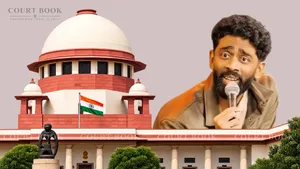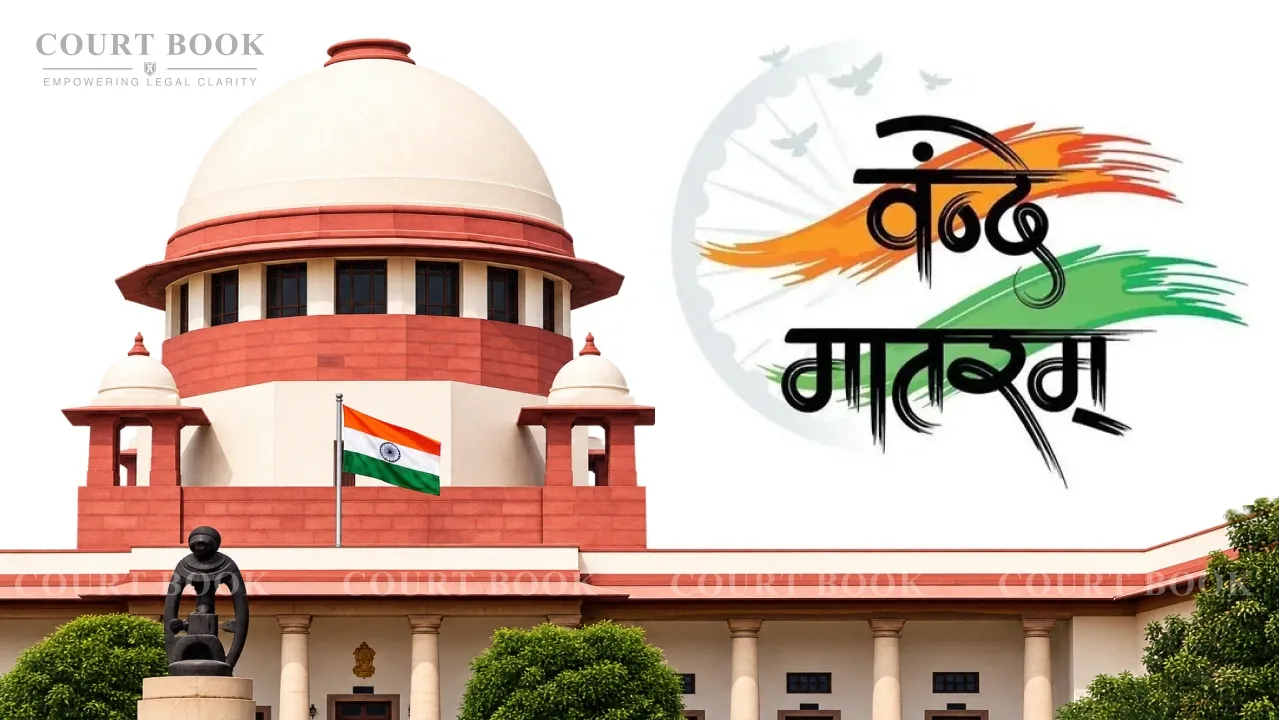
The Supreme Court on Tuesday sought the Union Government’s response to a constitutional challenge filed by Carnatic vocalist T.M. Krishna against the 2026 amendment to the Prevention of Insults to National Honour Act, 1971, and the Centre’s directions concerning the singing of all six stanzas of Vande Mataram at specified official functions.
A Bench comprising Chief Justice of India Surya Kant, Justice Joymalya Bagchi and Justice V. Mohana heard the petition. The Court directed the Centre to file its response within two weeks.
The challenge concerns the amended Section 3 of the 1971 Act, under which intentionally preventing the singing of the National Anthem or National Song, or causing disturbance to an assembly engaged in such singing, can attract imprisonment of up to three years, a fine, or both.
Krishna has also questioned the Ministry of Home Affairs directions prescribing the complete six-stanza version of Vande Mataram for specified governmental, ceremonial and cultural occasions.
Senior Advocate Dr S. Muralidhar, appearing for Krishna, submitted that the amended penal provision does not define what constitutes the “National Song”. He argued that relying on an Office Memorandum to determine conduct carrying criminal consequences raises questions of legal certainty.
The petition further contends that the last four stanzas contain references to Hindu deities and that compelling a person to sing them may raise issues concerning freedom of conscience, religion and expression. These are the petitioner’s constitutional challenges and remain to be adjudicated by the Court.
During the hearing, Justice Joymalya Bagchi referred to the Supreme Court’s 1986 decision in Bijoe Emmanuel v. State of Kerala, where the Court protected schoolchildren who respectfully stood during the National Anthem but did not sing it on grounds of religious belief.
Justice Bagchi indicated that the earlier judgment remains the law and should guide the application of the amended statute.
“We would expect that the law of the land, as declared by this Court in Bijoe Emmanuel, will govern the Act. The declaration of law in Bijoe Emmanuel is not yet questioned. It is for the democratic State to decide what is the national song, whether two stanzas or four stanzas. But nobody who feels an infraction of Article 25, 26 rights or a conscientious objector would be subjected to penal consequences.”
The Court also indicated that determining the content or scope of the National Song was not the immediate issue before it. Rather, the constitutional protection available to a conscientious objector was relevant to the question of criminal consequences
The hearing also witnessed an exchange between Dr Muralidhar and Solicitor General Tushar Mehta after the latter referred to “Naxalite” ideas while responding to submissions concerning the legislative process.
Muralidhar objected to the expression and sought its withdrawal. Mehta declined to retract it. The Bench subsequently made it clear that it was confining itself to the constitutional issues involved in the petition and was not taking note of the comments.
The Supreme Court directed the Union Government to respond to Krishna’s petition within two weeks. The Bench also indicated that the principle laid down in Bijoe Emmanuel concerning conscientious objection would govern the application of the amended law while the constitutional challenge is considered.