

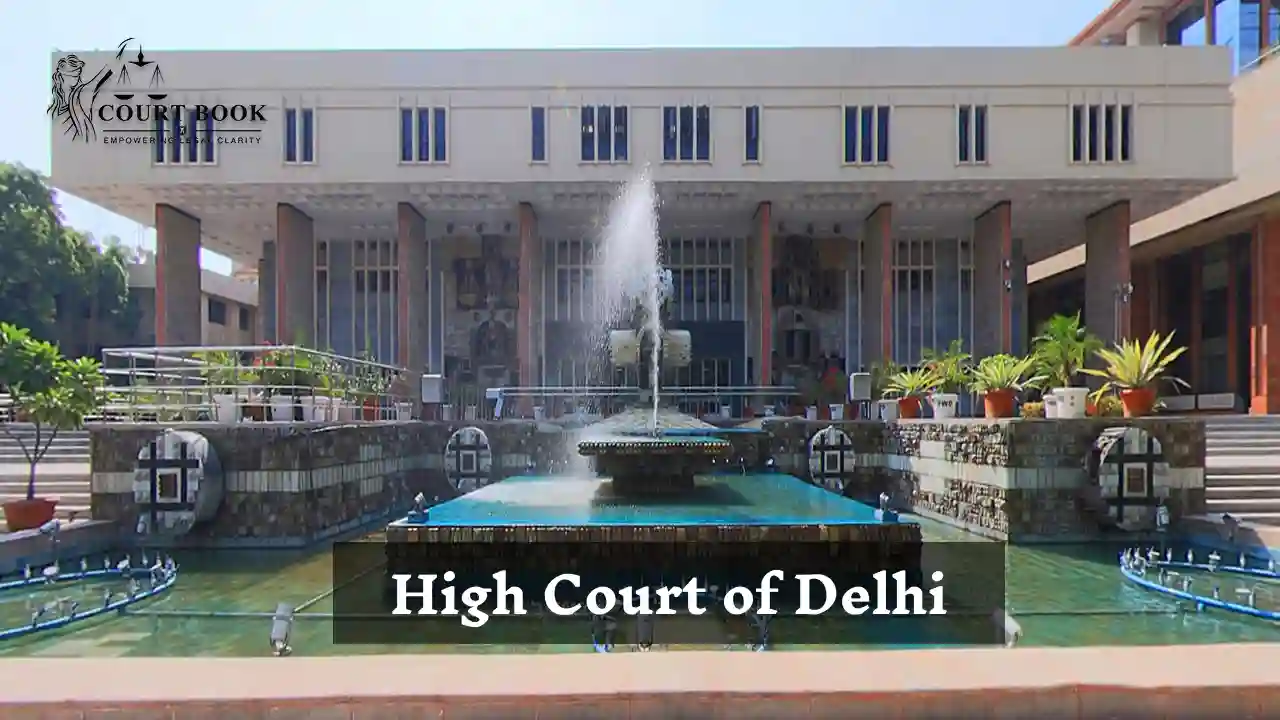
The Delhi High Court has ruled that a childless widow of a deceased CRPF personnel can continue to receive family pension even after remarriage, and the dependent parents cannot claim that pension as long as the widow remains eligible under service rules. The court dismissed a writ petition filed by the parents of a CRPF constable who died on duty during floods in Jammu and Kashmir.
The judgment was delivered by a division bench of Justice Anil Kshetarpal and Justice Amit Mahajan on January 27, 2026.
Background of the Case
The petition was filed by Smt. Lakshmi Devi and another, parents of late CT/Bug Bhim Singh, a constable with the 90th Battalion of the Central Reserve Police Force (CRPF). Bhim Singh died in September 2014 while performing official duties during rescue operations amid severe flooding at an outpost in Anantnag district, Jammu & Kashmir.
After his death, family pension was sanctioned to his widow, Anita Devi, in accordance with Rule 54 of the Central Civil Services (Pension) Rules, 1972. At that time, she was a childless widow with no independent income.
The parents later approached authorities claiming that the widow had remarried and sought transfer of the family pension to themselves, asserting financial dependence on their deceased son.
Parents’ Challenge
The parents argued that once the widow remarried and later had a child from the second marriage she should no longer be treated as part of the deceased employee’s family. They contended that continuing pension in her favour was unfair and unconstitutional, especially when aged parents were left without support.
They also challenged Rule 54 of the CCS (Pension) Rules and an Office Memorandum dated September 2, 2008, claiming these provisions discriminated against dependent parents and violated Article 14 of the Constitution.
Government’s Stand
The Union of India and CRPF authorities opposed the plea, stating that the rules clearly allow a childless widow to continue drawing family pension even after remarriage, provided her income remains below the prescribed limit.
They pointed out that under Rule 54, parents are eligible for family pension only if the deceased employee leaves behind neither a widow nor a child. Since the widow was alive and eligible, the parents’ claim could not arise.
Court’s Observations
The High Court held that family pension is not an inherited right but a statutory benefit, strictly governed by rules.
“The entitlement to family pension flows from Rule 54 and not from considerations of sympathy or equity,” the bench observed.
The court clarified that the term “family in relation to a government servant” refers to relationships existing at the time of the employee’s death. A child born to the widow from a subsequent marriage does not create any legal connection with the deceased employee.
Relying on Supreme Court precedent, the bench noted that relationships formed after the death of the government servant are legally irrelevant for deciding pension eligibility.
Rejecting the constitutional challenge, the court said the classification between widows and parents is clear, rational, and policy-driven. Giving priority to widows, including remarried childless widows, is a conscious welfare choice by the rule-making authority.
“The court cannot rewrite pension rules merely because another arrangement appears more compassionate,” it added.
Final Decision
The High Court found no illegality or arbitrariness in continuing the pension to the widow and upheld the Office Order dated August 10, 2017. It ruled that the parents do not acquire any enforceable right to family pension as long as an eligible widow exists.
The writ petition was dismissed.
Case Title: Smt. Lakshmi Devi & Anr. v. Union of India & Ors.
Case Number: W.P.(C) No. 11263 of 2023 with CM Appl. 43849/2023
Judgment Pronounced On: 27 January 2026
Counsel for Petitioners:
• Mr. Deepak Kohli, Advocate
• Mr. Rishi Vohra, Advocate
Counsel for Respondents:
• Mr. Nirvikar Verma, SPC
• Mr. Vinod Sawant, Law Officer
• Insp. Athurv and Mr. Ramniwas Yadav (CRPF)
Download Judgment

