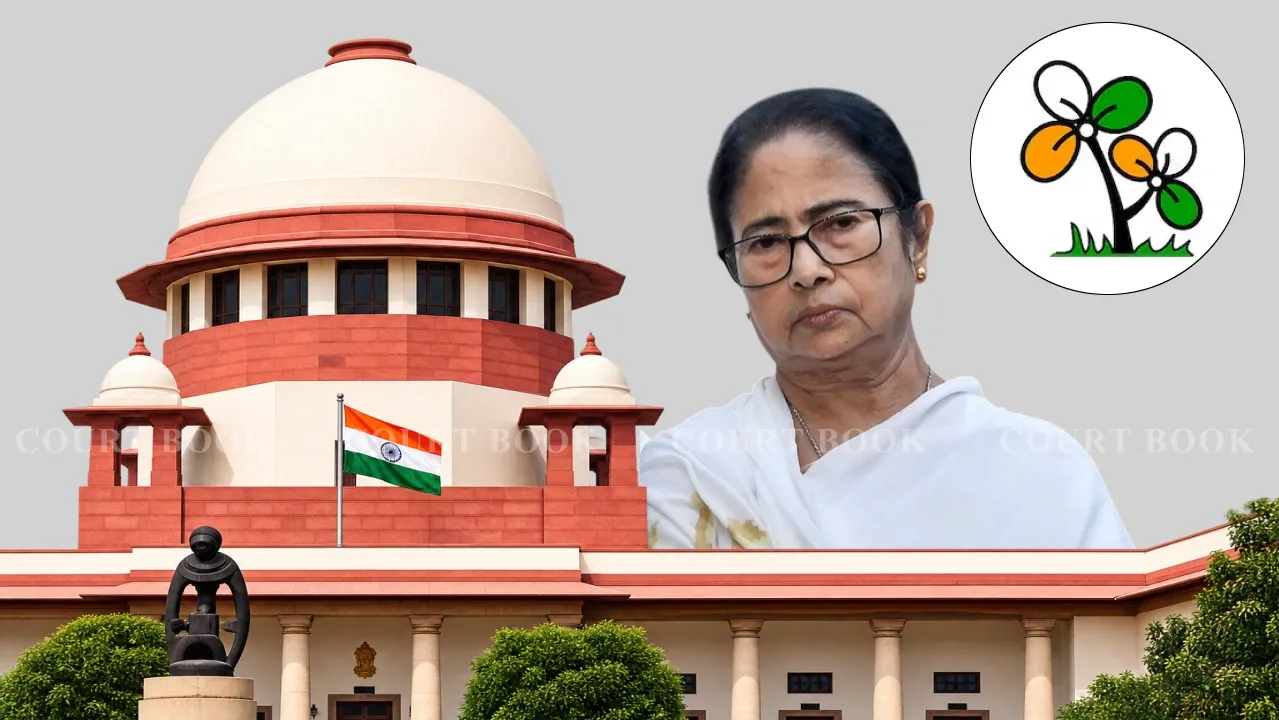
The Supreme Court on September 24 asked the Election Commission of India (ECI) to indicate how much time it would require to finally decide the dispute between rival factions of the All India Trinamool Congress (AITC) over the party’s name and its “Flowers and Grass” election symbol. The Court stressed that the proceedings should give both sides a fair opportunity to present their evidence without allowing the matter to remain pending for an unnecessarily long period.
A Bench comprising Chief Justice of India Surya Kant, Justice Joymalya Bagchi and Justice V. Mohana was hearing a writ petition filed by former West Bengal Chief Minister Mamata Banerjee challenging the ECI’s September 17 interim order concerning the party’s name and symbol.
Background
The dispute concerns competing claims over the identity and organisational control of the AITC. The ECI, after finding rival groups claiming the party’s identity, passed an interim arrangement on September 17 ahead of the October 6 by-elections in West Bengal.
Under that arrangement, neither faction was permitted to use the original AITC name and “Flowers and Grass” symbol for the notified by-elections. The Mamata Banerjee-led faction was allotted the name “Mamata All India Trinamool Congress” with the “Football Player” symbol, while the rival faction led by Ritabrata Banerjee was allotted “Democratic Trinamool Congress” with the “Envelope” symbol. The ECI clarified that these were interim arrangements and that the substantive dispute over the original name and symbol would be decided separately.
Senior Advocate Kapil Sibal, appearing for Mamata Banerjee, questioned the timing of the ECI’s interim order. He submitted that the dispute had remained pending for months and that the order was passed after the by-election process had already begun.
Sibal said that the timing of the order left the petitioner with limited opportunity to seek a legal remedy. He therefore pressed the Supreme Court to ensure that the main dispute before the ECI was decided expeditiously rather than seeking to halt the scheduled by-elections.
He submitted:
“Can the Election Commission delay matters, and then pass orders in the midst of elections knowing that I won't have a remedy? You have passed this order in the midst of elections; I can't file a writ petition, I can't go to Court.”
The Bench, however, noted that the election schedule had already been notified. Justice Bagchi observed that the interim arrangement could not simply be disturbed at this stage of the election process.
The Chief Justice focused on the time required for the ECI to conduct a fair final adjudication. The Court indicated that both sides should receive a proper opportunity to place their evidence, while the proceedings should not continue indefinitely.
CJI Surya Kant asked the Election Commission to work out a realistic timeframe, observing:
“Find out, for final adjudication, how much time are you expected to take? Only for this limited purpose....reasonable time in which parties are given fair opportunity and you have time to apply mind...but not too long.”
The rival faction’s counsel, Senior Advocate Mukul Rohatgi, opposed an overly short deadline and sought sufficient time for the proceedings. Senior Advocate Neeraj Kishan Kaul also submitted that the dispute involved factual issues requiring affidavits and evidence and that one month could be insufficient.
Justice Bagchi referred to the experience of the earlier Shiv Sena dispute, observing,
“We have seen what delay does in Shiv Sena Sir.”
The Supreme Court did not disturb the ongoing by-election process or the ECI’s interim arrangement at this stage. Instead, it sought clarity from the Election Commission regarding the realistic timeframe required to finally decide the dispute over the AITC’s original name and election symbol.
The matter was adjourned for further consideration.



-300x169.webp)
-300x169.webp)