

The Supreme Court held that bail jurisdiction under Section 483 BNSS is strictly limited to deciding release or custody - broader administrative directions fall outside its scope.
A cheating and forgery case registered in 2002 at Police Station Hamirpur, Uttar Pradesh - under Sections 419, 420, 467, 468 and 471 of the Indian Penal Code - became the unlikely trigger for a significant constitutional ruling by the Supreme Court of India.
The accused, Rambalak, had approached the High Court of Judicature at Allahabad seeking bail for the second time. The High Court, vide order dated April 1, 2025, rejected that application (CRMBA 9700 of 2025). But the rejection was not all that the High Court did.
While dismissing the bail application, the Court directed the Trial Court to issue summons under Sections 62 and 69 CrPC and take coercive measures against those persons who delay or impede proceedings. Further, the High Court reiterated a set of sweeping directions - originally framed by the State government and the Director General of Police, Uttar Pradesh - which had been adopted as court orders in two earlier bail matters, Bhanwar Singh @ Karamvir v. State of U.P. (CRMBA 16871 of 2023) and Jitendra v. State of U.P. (CRMBA 9126 of 2023).
Read Also:- Supreme Court Upholds Stray Dog Removal Order, Allows Euthanasia of Dangerous Dogs
The origins of these directions go back to September 2023. In Jitendra v. State of U.P., a learned Single Judge of the Allahabad High Court observed that the criminal justice system in Uttar Pradesh was suffering from serious difficulties in the delay of execution of summons and production of witnesses.
The Court called for personal affidavits from the Additional Chief Secretary (Home), Government of Uttar Pradesh, and the Director General of Police, on issues including the failure of the existing accountability system, the need for an efficacious departmental accountability mechanism, and penalties for failure to comply with court orders.
In response, the Principal Secretary (Home), Government of U.P., issued Government Order No. HC-100/6-PO-9-2023 dated October 14, 2023, and the Director General of Police issued a separate circular dated October 10, 2023. These directions included, among other things:
• Appointment of a Superintendent of Police rank officer as Nodal Officer in every district for execution of summons and warrants
• Preparation of a central register for all processes received from trial courts
• Weekly examination of the summons/warrants execution register by Nodal Officers
• Monthly statements on service of processes to be placed before the Nodal Officer
• Written warnings to lax officers, and show-cause notices after three consecutive months of laxity
• Monitoring by Deputy/Additional Superintendent of Police at district level and Assistant Police Commissioners at Commissionerate level
By order dated December 20, 2023, in Jitendra, the High Court formally adopted these government directions as orders of the Court, directing strict compliance by the Director General of Police and other responsible officials.
It was these very directions that the High Court reiterated in its April 2025 order while rejecting Rambalak's bail application.
Read Also:- Final Decree Proceedings Not Needed If Preliminary Decree Already Provides Mode of Partition: Supreme Court
Rambalak filed a Special Leave Petition (Crl.) No. 16332 of 2025 before the Supreme Court against the rejection of his bail application. On first reading, the appeal appeared to raise only the limited issue of bail rejection. But, as the Supreme Court noted, "it is not so."
By interim order dated November 26, 2025, the Supreme Court released Rambalak on bail. The Court then posted the matter for further consideration on a separate and more significant legal question - whether a High Court has the power to issue such directions while exercising bail jurisdiction.
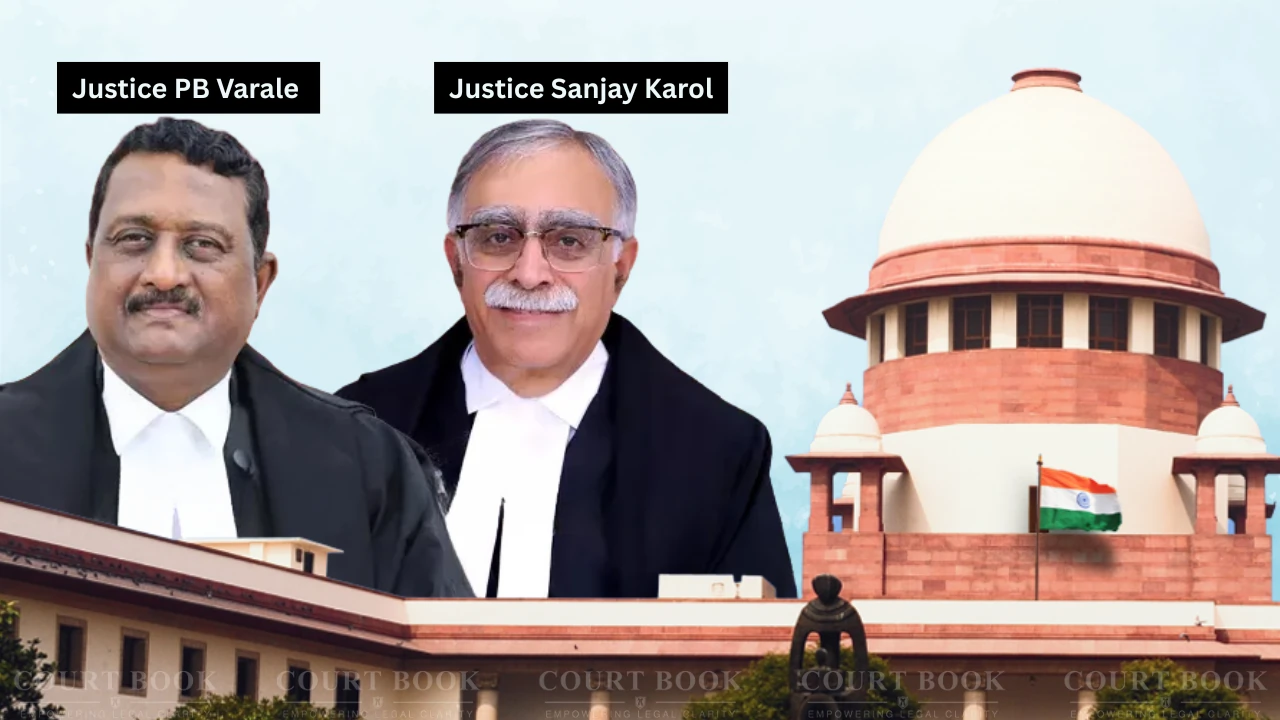
A bench of Justices Sanjay Karol and Prasanna B. Varale identified the sole question for consideration: whether, under Section 483 of the Bharatiya Nagarik Suraksha Sanhita (BNSS), 2023, a High Court could have issued such directions while deciding a bail application.
Section 483 BNSS - the provision governing special powers of the High Court or Court of Session regarding bail - permits the Court to direct release of an accused on bail, modify conditions imposed by a Magistrate, or direct arrest of a person already released on bail. It does not, on its face, contemplate any other exercise of power.
The Court heard arguments from counsel for the appellant, the State, and amicus curiae Ms. Akriti Chaubey, and also considered written submissions of the parties.
The Court placed strong reliance on its earlier decision in State of U.P. v. Anurudh (2026 SCC OnLine SC 40), another case arising from the Allahabad High Court, where far-reaching directions had been issued under bail jurisdiction mandating scientific determination of the age of victims in POCSO cases - directions that the Supreme Court had held to be impermissible.
Reaffirming that ruling, the Supreme Court drew a decisive distinction between constitutional powers and statutory powers of the High Court.
The Court explained that constitutional powers emanate directly from the text and spirit of the Constitution - they are self-sustaining, cannot be abridged by legislation, and derive legitimacy from the sovereignty of the Constitution itself. Statutory powers, by contrast, are derivative and conditional, drawing their authority from legislation and existing only within the four corners of the enabling statute.
The Court held that the bail jurisdiction exercised by the High Court in the present case was a statutory power under Section 483 BNSS - not a constitutional power. As such, it was strictly circumscribed by the language and purpose of that provision.
Critically, the Court observed:
"The constitutional power cannot overshadow the statutory power, enlarging its scope beyond what has been envisaged by the statute. One power cannot usurp the ambit of another, unless otherwise permitted by law."
The Court further held, reiterating Anurudh, that:
"A Court's jurisdiction, i.e., either the Court of Sessions or the High Court under Section 439 CrPC is limited to adjudicating the question of the person concerned being released into society pending trial or whether they should continue to be incarcerated."
The Supreme Court allowed the appeal and set aside the impugned directions issued by the Allahabad High Court to the extent they reiterated the earlier bail orders in Bhanwar Singh and Jitendra.
However, in the interest of justice, the Court made an important clarification - all steps already taken by the State authorities pursuant to those directions shall remain unaffected and continue to function independently of the orders in which they were issued. The State was also given liberty to modify those measures to bring them in consonance with the prevalent laws of the land, should the need arise.
The Court further clarified that in setting aside the directions on account of jurisdictional error, it had made no comment on the grant or denial of bail in the earlier orders.
The interim bail order dated November 26, 2025, was confirmed. All pending applications stood disposed of.
Case Title:- RAMBALAK Vs. STATE OF U.P.
Download Judgment

