

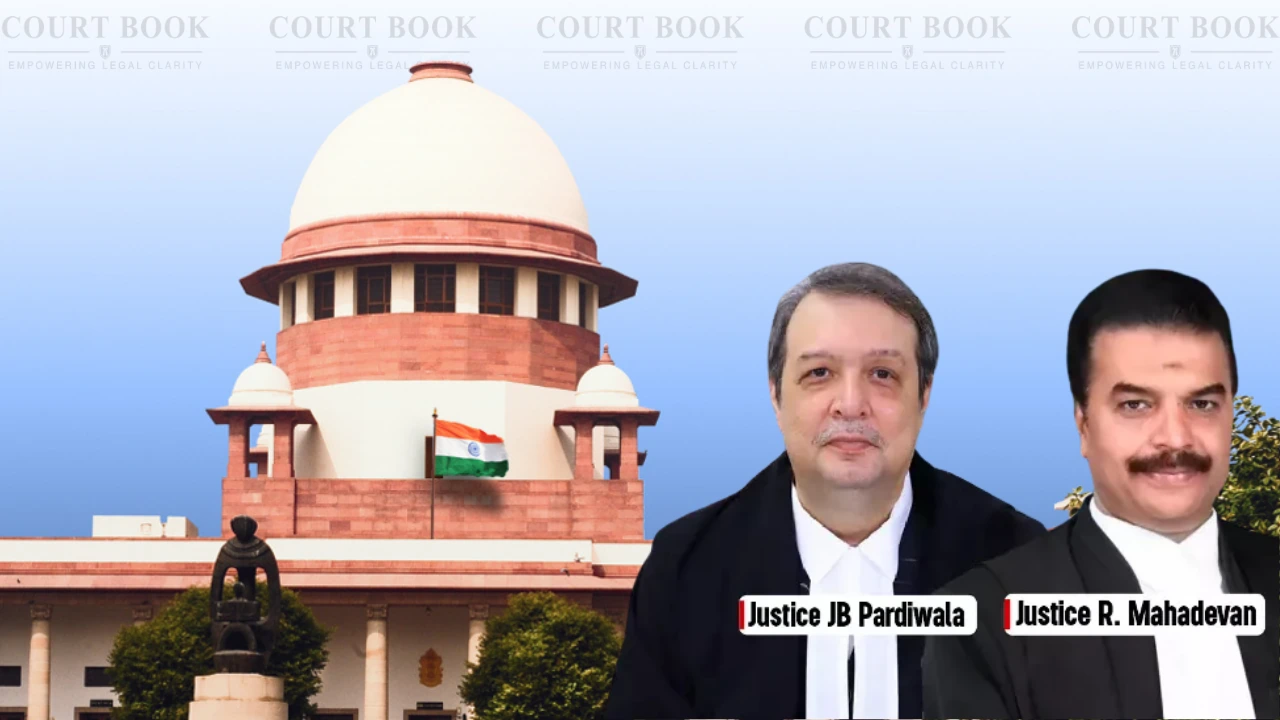
The Supreme Court of India recently dealt with an important constitutional challenge concerning maternity benefits available to adoptive mothers under India’s social security framework.
The petition questioned the validity of a statutory provision that grants maternity benefits only when a woman adopts a child below the age of three months, arguing that it discriminates against adoptive mothers of older children and violates fundamental rights.
The Court examined whether this classification is constitutionally permissible under Articles 14 and 21 of the Constitution, while also addressing broader issues surrounding motherhood, child welfare, and workplace equality.
Background of the Case
The case arose from a writ petition filed under Article 32 of the Constitution by petitioner Hamsaanandini Nanduri, an adoptive mother of two children.
Read also:- J&K High Court Upholds Eviction Appeal Rule, Says ‘Symbolic Possession’ Enough to File Appeal
She challenged Section 5(4) of the Maternity Benefit Act, 1961, as amended in 2017. The provision grants 12 weeks of maternity benefit to a woman who legally adopts a child below the age of three months.
During the pendency of the petition, the Code on Social Security, 2020 came into force. The corresponding provision now appears as Section 60(4) of the Code, which retains the same age-based eligibility condition for adoptive mothers.
The petitioner therefore amended the writ petition to challenge the validity of the new provision as well.
Counsel for the petitioner argued that the provision creates an unreasonable classification among adoptive mothers.
Read also:- Rajasthan HC Finds Possible Personal Interest in PIL, and Issues ₹25 Lakh Cost Notice
It was submitted that the law distinguishes between:
• women adopting a child below three months, and
• women adopting a child above three months.
According to the petitioner, this distinction is arbitrary and unconstitutional, as adoptive mothers of older children also require time to care for the child and develop emotional bonding.
Another argument highlighted that the adoption process under the Juvenile Justice Act and CARA regulations itself takes considerable time. Consequently, many adoptions cannot practically occur before a child turns three months old.
The Union of India opposed the challenge, arguing that the provision strikes a balance between employee welfare and employer interests, while focusing on the critical early months of childcare.
Read also:- Anganwadi Worker Recruitment: SC Says Graduates Can Compete in 29% Quota for ICDS Supervisor Posts
The Supreme Court emphasized that maternity protection is a fundamental aspect of human dignity and workplace equality.
The Court observed that maternity benefits are designed not only for physical recovery after childbirth but also to support caregiving and emotional bonding between the mother and the child.
Importantly, the Court noted that motherhood is not confined to biological childbirth, and adoptive mothers play an equally vital role in nurturing and integrating a child into the family.
The judgment stated that maternity leave generally serves three key purposes:
1. Recovery after childbirth (in biological cases)
2. Development of emotional bonding between mother and child
3. Care and integration of the child into the family environment.
In adoption cases, while physical recovery is not involved, the latter two objectives remain highly significant.
The Supreme Court examined whether the three-month age limit for adopted children constitutes a valid classification under Article 14 of the Constitution.
The Court explained that although legislation may classify individuals, such classification must be based on an intelligible differentia and must have a rational nexus with the objective of the law.
The Court therefore undertook a detailed constitutional analysis to determine whether the impugned provision unjustifiably excludes adoptive mothers of children above three months from maternity benefits.
The judgment also discussed the broader principles of social security, gender equality, and child welfare, emphasizing that maternity protection is an important element of India’s labour welfare framework.
Case Title: Hamsaanandini Nanduri v Union of India & Ors
Case Number: Writ Petition (Civil) No. 960 of 2021
Judge: Justice Pardiwala and Justice R. Mahadevan
Download Judgment

