

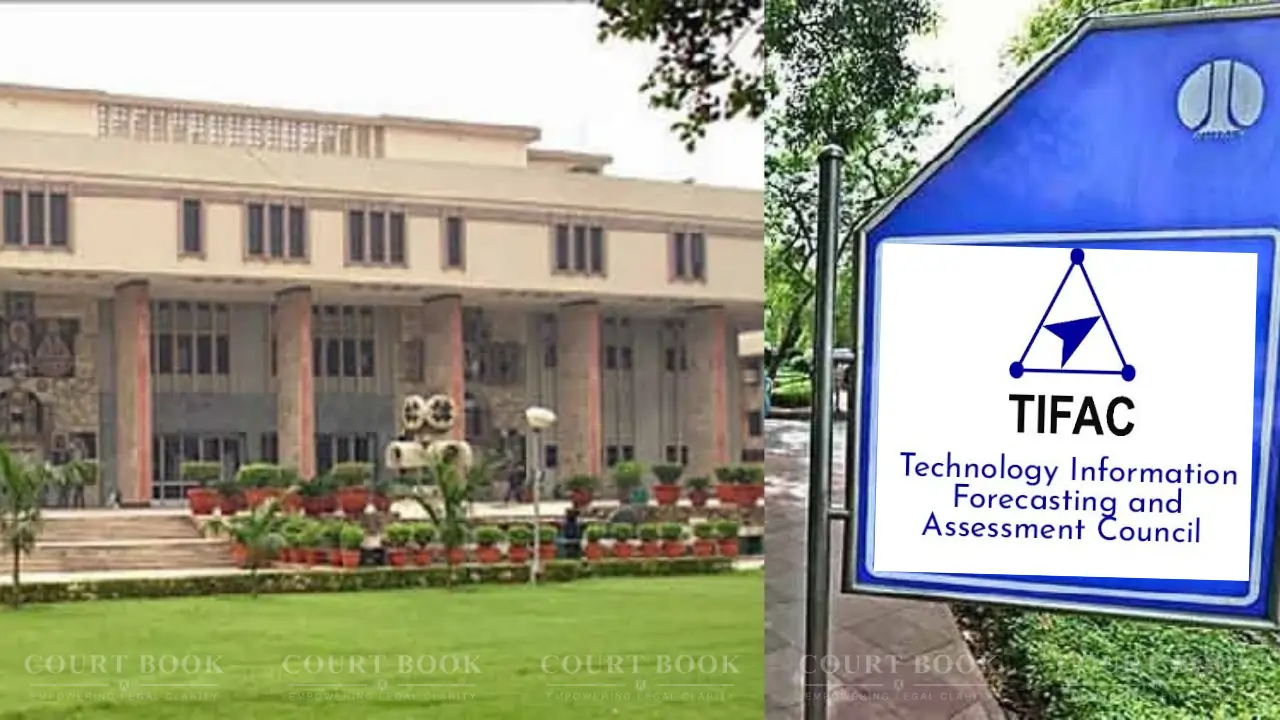
The Delhi High Court on Friday stepped in to settle a long-running dispute between a government-backed technology body and a private engineering firm, setting aside an arbitration award that had tried to strike a middle path. Sitting in a packed courtroom, Justice Jasmeet Singh made it clear that an arbitrator cannot go beyond what the contract itself says, even if the project story looks messy on the ground.
हिंदी में पढ़ें
Background
The case arose from a technology development agreement signed back in 1999. The Technology Information Forecasting and Assessment Council (TIFAC), under the Department of Science and Technology, had funded Strategic Engineering Pvt. Ltd. to develop composite CNG cylinders. The idea was simple on paper: TIFAC would fund the development, and once the technology was declared successful by an expert committee, Strategic Engineering would repay the assistance in instalments.
Read also:-Himachal Pradesh High Court Upholds Bus Driver’s Acquittal, Says Mechanical Brake Failure Ruled Out Rash Driving Allegations in 2007
Things, however, did not go smoothly. While an Advisory and Monitoring Committee (AMC) later declared the project a “success,” commercial production ran into trouble, especially after delays and restrictions in importing a key machine from the US. Payments were disputed, cheques bounced, and the matter eventually went to arbitration.
In 2019, the arbitrator passed an award allowing some claims from both sides. Not satisfied, both TIFAC and Strategic Engineering approached the High Court under Section 34 of the Arbitration Act.
Read also:-Jharkhand High Court Grants Final Surrender Window to Sourav Bardhan in ED Case, Modifies Earlier Bail Order Citing Supreme Court Law
Court’s Observations
Justice Singh spent considerable time walking through the agreement clauses and the AMC minutes. The court noted that under the contract, the trigger for repayment was not commercial success but the successful development of technology, as certified by the AMC.
“The arbitrator,” the bench observed, “introduced commercial viability as a condition where none existed in the contract.” That, the court said, amounted to rewriting the agreement itself.
The judge also pointed out that the AMC had, in fact, declared the project successful in its fifth meeting, and Strategic Engineering had not objected at the time. In fact, post-dated cheques were handed over acknowledging repayment obligations. “Once the competent authority under the contract certifies success, the repayment clause gets activated,” the court remarked, adding that an arbitrator cannot sit in appeal over such certification.
The High Court was blunt in its assessment, saying the award suffered from “patent illegality” because it ignored clear contractual terms and substituted them with the arbitrator’s own reasoning.
Read also:-Supreme Court steps in Punjab fraud case, issues notice and grants interim bail protection to Harjit Kaur against possible arrest
Decision
In the end, the court allowed both petitions and set aside the arbitral award dated December 14, 2019, in its entirety. With the award gone, Strategic Engineering’s separate challenge to one part of the decision was rendered meaningless. All pending applications were also disposed of, bringing this chapter of the dispute to a close-at least for now.
Case Title: Technology Information Forecasting and Assessment Council (TIFAC) vs Strategic Engineering Pvt. Ltd. & Anr.
Case No.: O.M.P. (COMM) 548/2020 and O.M.P. (COMM) 128/2021
Case Type: Commercial Arbitration – Petition under Section 34, Arbitration and Conciliation Act, 1996
Decision Date: 20 December 2025


