

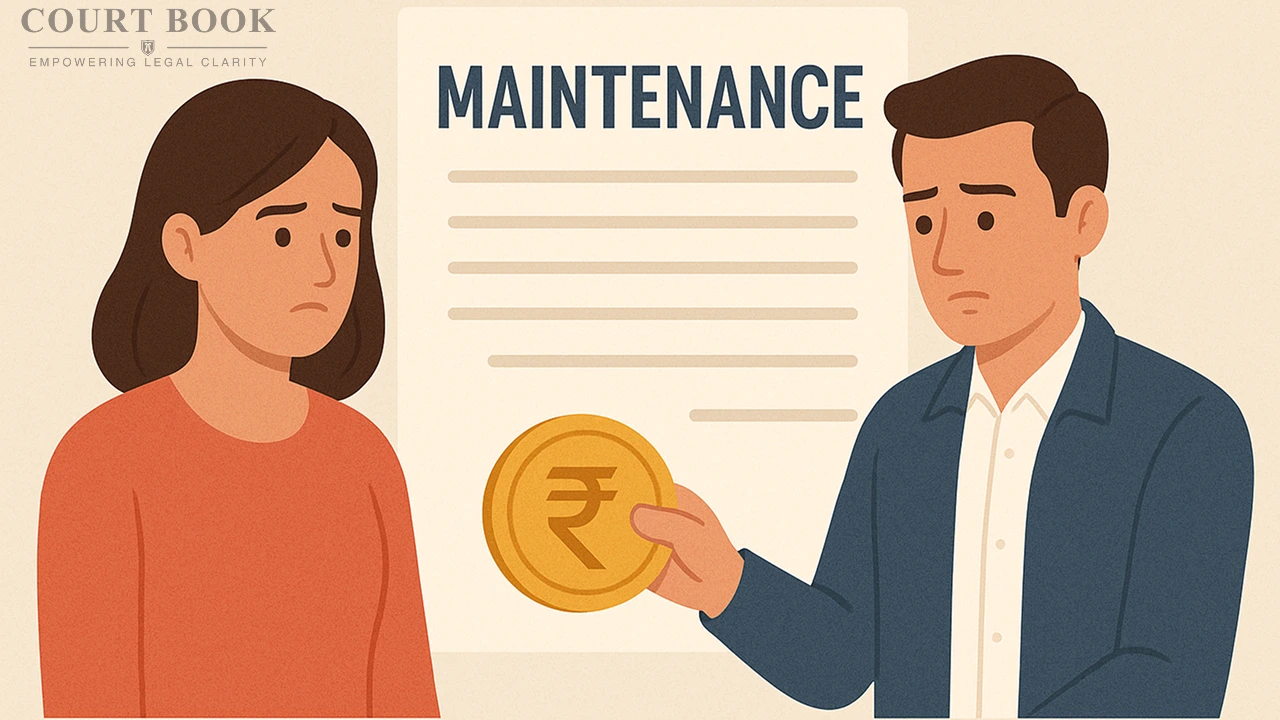
The High Court of Jammu & Kashmir and Ladakh has refused to restore a maintenance order in favour of a woman who had been living separately from her husband for decades by mutual consent. While upholding the revisional court’s decision denying maintenance, the court directed the husband to pay ₹2.5 lakh as a one-time settlement to prevent the petitioner from falling into financial hardship.
Justice Sanjay Parihar delivered the judgment while deciding two connected petitions arising from a long-running matrimonial dispute between Sarita Devi and Mohan Singh.
Read also:-Chhattisgarh High Court Quashes Criminal Complaint Against Judges, Says Allegations Based
Background of the Case
The couple married in 1990 and had a son from the marriage. According to the record, the relationship deteriorated after the wife alleged that her husband had contracted a second marriage. She initiated criminal proceedings for bigamy along with a maintenance petition.
In 1995, however, both sides entered into a compromise. The wife withdrew her complaints and maintenance proceedings after receiving ₹10,000 as full and final settlement, and the parties began living separately. The court noted that a customary separation document (farkhatnama) was also executed.
Years later, the petitioner filed multiple proceedings seeking maintenance, including claims on behalf of her minor son. Over time, the maintenance for the child was enhanced through different orders until he attained majority.
In 2008, the petitioner again approached the court seeking maintenance for herself under Section 488 Cr.P.C. The Chief Judicial Magistrate eventually granted her maintenance of ₹2,000 per month with 10% annual enhancement from the date of filing.
However, the husband challenged that order before the Sessions Court.
Read also:-Bombay High Court Upholds Deemed Conveyance to Housing Society, Says Builder Cannot Retain FSI
Revisional Court’s Findings
The Principal Sessions Judge, Ramban, set aside the Magistrate’s order in November 2020.
The revisional court held that the parties had been living separately by mutual consent since their settlement in 1995. Under Section 488(5) Cr.P.C., a wife is not entitled to maintenance if she is living apart from her husband by mutual agreement.
The wife then moved the High Court challenging this finding.
Court’s Observations
Justice Sanjay Parihar examined the long history of litigation between the parties and their conduct over the years.
The court noted that the petitioner had previously withdrawn legal proceedings after accepting settlement money, described herself as divorced in later proceedings, and lived separately from the respondent for more than a decade.
The judgment observed:
“The petitioner withdrew earlier proceedings after accepting ₹10,000 as full and final settlement and subsequently represented herself as divorced in later proceedings.”
Although the respondent failed to prove the existence of a valid customary divorce, the court said that the evidence clearly showed that the couple had chosen to live apart by mutual consent.
The court further explained that even if a marriage technically subsists in law, maintenance may still be denied if the separation is consensual.
Read also:-Kerala High Court Quashes Ombudsman Proceedings Against Village Officer, Says He Is Not
The judge observed:
“Even assuming the marriage legally subsisted, the petitioner’s own admissions and conduct demonstrate that she was residing separately by mutual consent.”
Because of this, the statutory bar under Section 488(5) Cr.P.C. applied.
Consideration of Financial Circumstances
Despite dismissing the claim for maintenance, the High Court acknowledged the petitioner’s financial condition.
The court noted that she had been living separately since 1995 and appeared to have no independent source of income, relying on her son for support.
The judge also took into account that in earlier proceedings the respondent had agreed to pay ₹2.5 lakh as full settlement, though the arrangement failed when the amount was not paid within time.
Court’s Decision
To balance the circumstances, the High Court directed the respondent to pay ₹2.5 lakh as a one-time settlement within six months.
Read also:-Gurmeet Ram Rahim Acquitted in Journalist Murder Case, Punjab & Haryana HC Upholds Life Term
The court ordered that the amount already deposited in court, including funds kept in a fixed deposit, be released to the petitioner. Any remaining balance must be paid by the respondent within the stipulated period, failing which the amount will carry 6% annual interest until recovery.
Accordingly, the High Court dismissed the wife’s petition challenging the revisional order, and the connected petition filed by the husband was also disposed of.
Case Title: Sarita Devi v. Mohan Singh
Case No.: CRM(M) No. 444/2020 with CRM(M) No. 279/2021
Decision Date: 06 March 2026
Download Judgment

