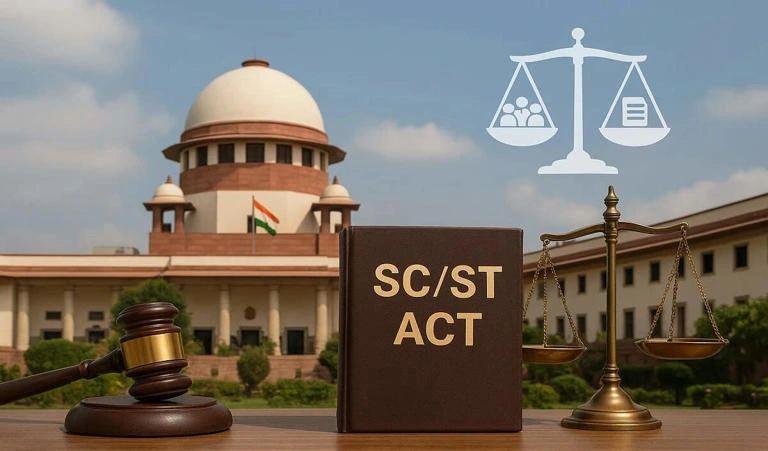
The Supreme Court on January 12, 2026, set aside criminal proceedings against a Bihar man accused under the SC/ST (Prevention of Atrocities) Act, holding that vague allegations and mere presence at the spot cannot justify putting someone through a criminal trial. The court found that the basic legal requirements to attract offences under the Act were missing in this case
Background of the Case
The case arose from an incident in 2019 at an Anganwadi Centre in Santhali Tola, Bhagalpur district. According to the First Information Report (FIR), the complainant, who belongs to a Scheduled Caste, alleged that a group of accused persons abused and threatened him, including by using caste-related words.
Based on the FIR, police filed a chargesheet against Keshaw Mahto, also known as Keshaw Kumar Mahto, and others. In October 2020, a Special Court under the SC/ST Act took cognisance of offences under several sections of the Indian Penal Code, such as wrongful restraint and causing hurt, along with Sections 3(1)(r) and 3(1)(s) of the SC/ST Act.
Mahto challenged the summoning order before the Patna High Court, but his appeal was dismissed in February 2025. He then approached the Supreme Court.
What the Supreme Court Examined
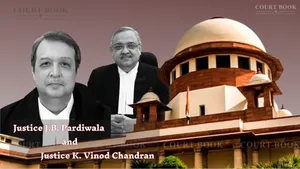
A Bench of Justice J.B. Pardiwala and Justice Alok Aradhe closely examined whether the allegations against Mahto were strong enough to justify a criminal trial.
During the hearing, the court specifically asked the State to point out material showing Mahto’s direct role. The State fairly conceded that there was no specific act attributed to him, except that he was allegedly present with the co-accused at the time of the incident.
The bench then analysed the legal ingredients required to make out offences under Sections 3(1)(r) and 3(1)(s) of the SC/ST Act.
Court’s Observations
The Supreme Court noted that for an offence under the SC/ST Act, it is not enough that the complainant belongs to a Scheduled Caste or Scheduled Tribe.
Read also:- No Reopening of 2015 Recruitment: Supreme Court Upholds Gujarat PSC Selection
“The allegations must show intentional insult or abuse, motivated by the caste of the complainant, and done with the clear intent to humiliate,” the bench observed.
The judges stressed that even uttering a caste name does not automatically attract the Act unless it is used as an abuse, in public view, with a humiliating intent.
In Mahto’s case, the court found that neither the FIR nor the chargesheet alleged that he himself used caste-based words or intentionally insulted the complainant.
“Mere presence of the appellant does not establish his participation in the alleged offence,” the court said, adding that the allegations against him were general and lacked substance.
Read also:- No Prosecution Without Govt Complaint: Kerala HC Quashes Case Against Notary Public
The bench also noted that continuing the trial in such circumstances would amount to a “travesty of justice.”
Final Decision
Allowing the appeal, the Supreme Court set aside the Patna High Court’s order and quashed the entire criminal prosecution against Keshaw Mahto.
The court held that the allegations, even if accepted at face value, did not disclose offences either under the SC/ST Act or under the IPC, so far as the appellant was concerned.
All pending applications were also disposed of.
Case Title: Keshaw Mahto @ Keshaw Kumar Mahto v. State of Bihar & Anr.
Download Order





 chief. Eknath Shinde – Shiv Sena leader-300x169.webp)
-300x169.webp)