

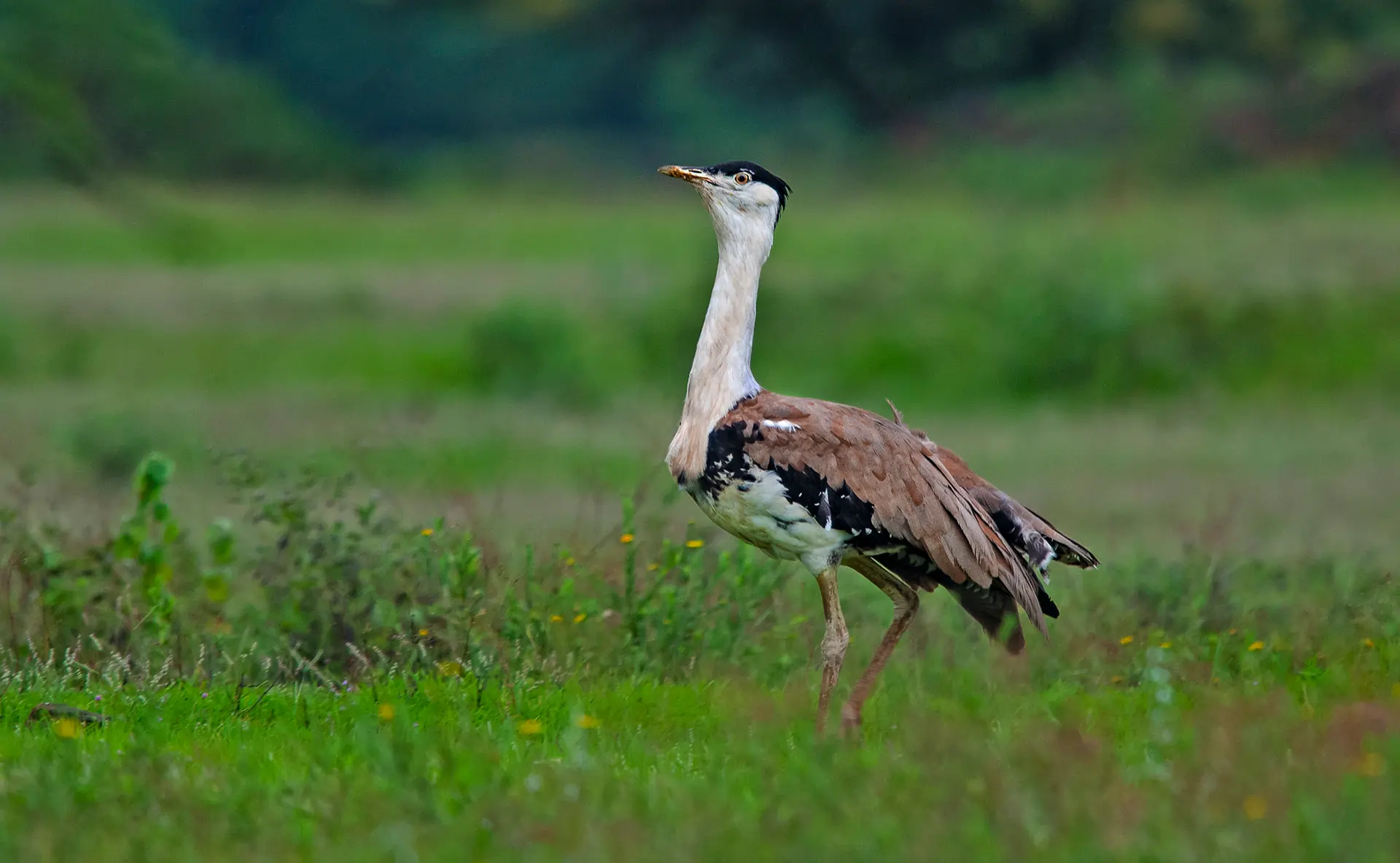
Inside Courtroom No. 1, the mood was quietly intense as the Supreme Court revisited one of its most watched environmental cases - the fight to save the Great Indian Bustard, or Godawan, from vanishing off India’s deserts. The case has long sat at an uneasy crossroads: wildlife protection on one side, India’s aggressive renewable energy targets on the other. On Friday, the Bench finally laid down a detailed road map, trying to steady both ends without tipping either over.
हिंदी में पढ़ें
Background
The petitions, led by conservationist M.K. Ranjitsinh, were filed back in 2019 when alarming data showed the Great Indian Bustard population crashing, largely due to collisions with overhead power lines in Rajasthan and Gujarat.
Read also:-Supreme Court Overturns Telangana High Court Orders, Says Expired Driving Licences Break Eligibility for Police Driver Recruitment Posts
In April 2021, the Court had taken a strong step - practically freezing overhead transmission lines across nearly 99,000 square kilometres. That order, however, triggered serious concerns from power ministries and renewable energy developers, who argued it was choking solar and wind expansion in some of India’s most energy-rich regions.
By March 2024, the Court itself acknowledged the difficulty of a blanket ban and constituted a high-level expert committee to suggest a more workable solution, grounded in science rather than judicial instinct alone.
Read also:-Supreme Court quashes ESI demand against Carborandum Universal, says Section 45A can’t replace proper adjudication when records
Court’s Observations
Reading from the committee’s findings, the Bench noted that the Godawan is particularly vulnerable because of its size, poor frontal vision, and slow breeding cycle. “The loss of even a single adult bird,” the court observed, “can have devastating consequences for the survival of the species.”
At the same time, the judges were careful not to romanticise conservation at the cost of climate realities. They recorded that forcing all high-voltage lines underground was neither technically feasible nor environmentally neutral. In one striking passage, the Bench remarked that climate change itself could wipe out multiple species if India failed to transition away from fossil fuels in time.
The court accepted the committee’s view that conservation and clean energy cannot be treated as enemies. “A holistic approach is required,” the Bench said, cautioning against “sweeping directions passed without the aid of domain expertise.”
Read also:-Supreme Court Restores Arbitral Award Against BALCO, Says High Court Overstepped Limits
Decision
In its final directions, the Supreme Court approved the expert committee’s recommendations almost in full. The priority habitat for the Great Indian Bustard in Rajasthan has been revised to about 14,013 sq km, while Gujarat’s revised priority area stands at 740 sq km.
No new overhead power lines - barring low-voltage lines - will be permitted in these revised priority areas except through designated power corridors. Several existing 33 kV and higher transmission lines must be undergrounded or rerouted on a strict timeline, with all major mitigation measures to be completed before 2028.
Read also:-Supreme Court Cancels Bail in Bihar Temple Murder Case, Says High Court Ignored Gravity
Significantly, the Court declined to mandate bird flight diverters for now, noting the lack of proven effectiveness and high costs, though it left the door open pending further scientific studies. Renewable energy projects above a specified capacity will also face restrictions within critical habitats.
Closing the matter, the Bench reminded corporations that environmental protection is not charity but obligation. Companies operating in bustard landscapes, it said, must act “as guests in the Godawan’s home,” bearing responsibility for the damage their infrastructure causes.
Case Title: M.K. Ranjitsinh & Others vs Union of India & Others
Case Type: Writ Petition (Civil) with Civil Appeal
Case No.: W.P. (C) No. 838 of 2019; C.A. No. 3570 of 2022 (with connected matters)
Date of Judgment: 19 December 2025
Download Judgment

