

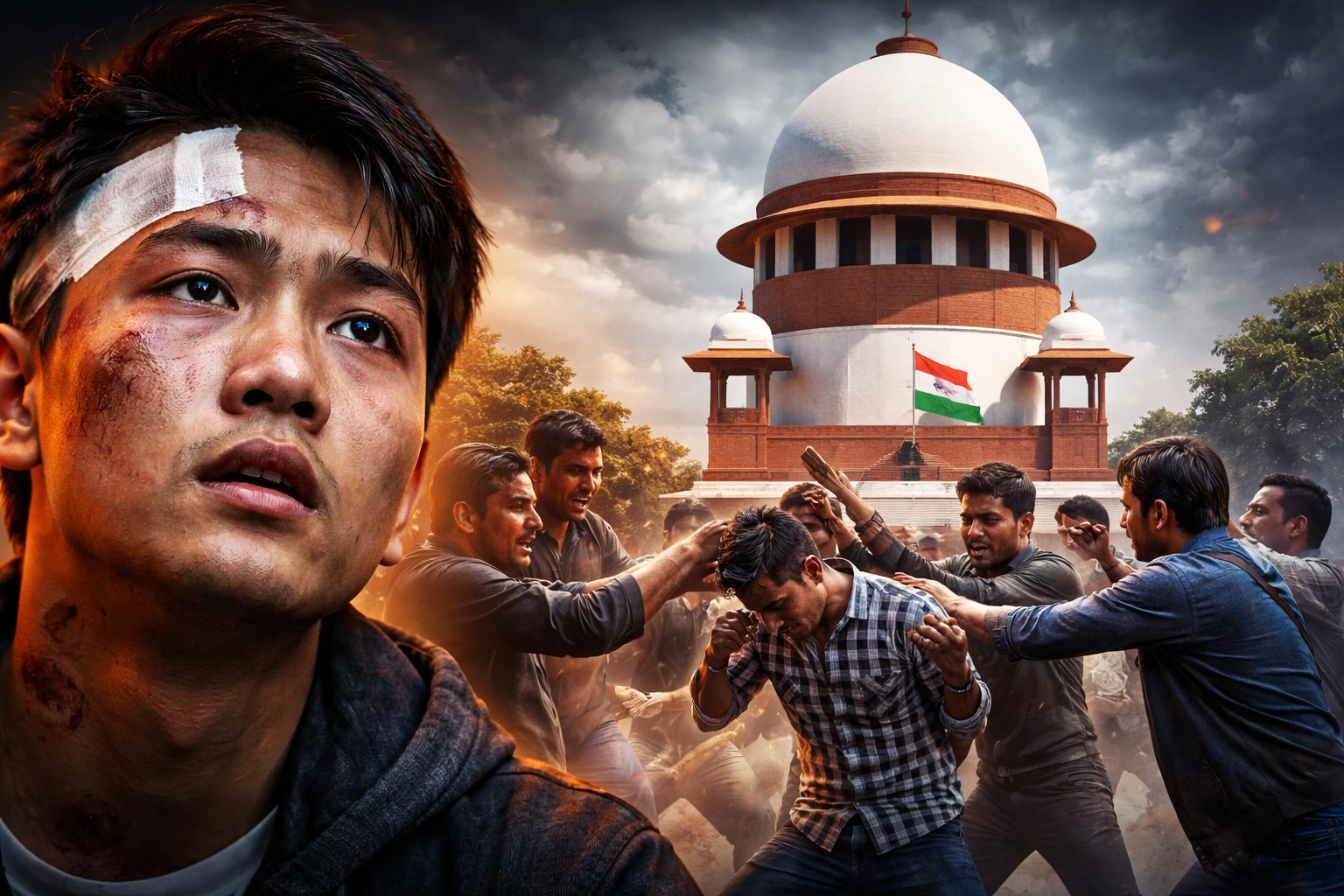
The Supreme Court on 30 December Tuesday heard a public interest litigation (PIL) seeking urgent judicial intervention after the death of 24-year-old Angel (Anjel) Chakma, a student from Tripura, who was allegedly racially attacked in Uttarakhand’s Dehradun earlier this month. The petition argues that the incident reflects a recurring “constitutional failure” to protect citizens from the North-Eastern states against hate-based violence.
Background of the Case
Chakma, a final-year MBA student, was attacked on December 9 in Dehradun’s Selaqui area, allegedly by a group of youths who hurled racial slurs before assaulting him with sharp weapons. He sustained serious injuries to his neck and abdomen and died after nearly two weeks in intensive care.
Read also:- IIT Mandi Cannot Be Forced Into CPWD Arbitration With Contractor, Himachal Pradesh High Court Rules
According to the complaint filed by his brother, the attackers taunted the brothers over their appearance. During the confrontation, Chakma reportedly asserted,
“We are not Chinese… We are Indians. What certificate should we show to prove that?” His words, now quoted in the petition, are described as his final stand before the violence escalated.
Petitioner’s Arguments
The PIL, filed under Article 32, contends that racially motivated assaults continue to be treated as “ordinary crimes,” which erases the motive and weakens the gravity of charges. The petitioner submits that even after the enactment of the Bharatiya Nyaya Sanhita (BNS) and Bharatiya Nagarik Suraksha Sanhita (BNSS), there is still no statutory recognition of racial or hate-based offences.
The plea states,
“There is no mechanism in the criminal justice system to identify, record, or investigate racial bias. This results in a cycle of impunity where motive and prejudice disappear from the legal record.”
Highlighting similar cases, including the 2014 death of Arunachal Pradesh student Nido Taniam in Delhi, the petitioner argues that the violence against North-Eastern citizens is not isolated but part of a continuing trend, acknowledged even in parliamentary discussions.
What the PIL Seeks
The petition asks the Supreme Court to frame interim guidelines similar to the Vishaka guidelines for workplace harassment until Parliament enacts a dedicated law. Key requests include:
• Recognition of racial crimes as a distinct constitutional wrong
• Dedicated police units and nodal officers for racial violence cases
• Recording racial motive at the FIR stage
• Victim protection measures and monitoring committees
• Awareness programmes in schools, colleges and public institutions
Read also:- J&K High Court Sends Furniture Supply Payment Dispute to Arbitration, Rejects UT’s Limitation Objection
It further argues that such discrimination violates Articles 14 (equality), 15 (non-discrimination), 19 (freedoms), and 21 (right to life) of the Constitution.
Courtroom Observations
During the preliminary hearing, the bench noted the sensitivity of the issue and asked the respondents to clarify the existing framework for reporting and tracking racially motivated violence. One of the judges reportedly remarked,
“If there is a recurring pattern, the Court must be satisfied that constitutional protections are not being reduced to theory.”
The matter has been placed for further consideration after notices were issued to the Union of India and other respondents.
Decision
The Supreme Court has issued notice and sought responses from the Union government and concerned authorities, marking the first formal step in examining the plea for nationwide safeguards against racially motivated violence.
The case will now return for the next hearing after the responses are filed.
Case Title:- Anoop Prakash Awasthi Versus Union of India & Ors.


